Category Archives: Uncategorized

The Extreme Monocots

Coconut palms grow some of the biggest seeds on the planet (coconuts), and the tiny black specks in very good real vanilla ice cream are clumps of some of the smallest, seeds from the fruit of the vanilla orchid (the vanilla “bean”). Both palms and orchids are in the large clade of plants called monocots. About a sixth of flowering plant species are monocots, and among them are several noteworthy botanical record-holders and important food plants, all subject to biological factors pushing the size of their seeds to the extremes. Continue reading

Walnut nostalgia

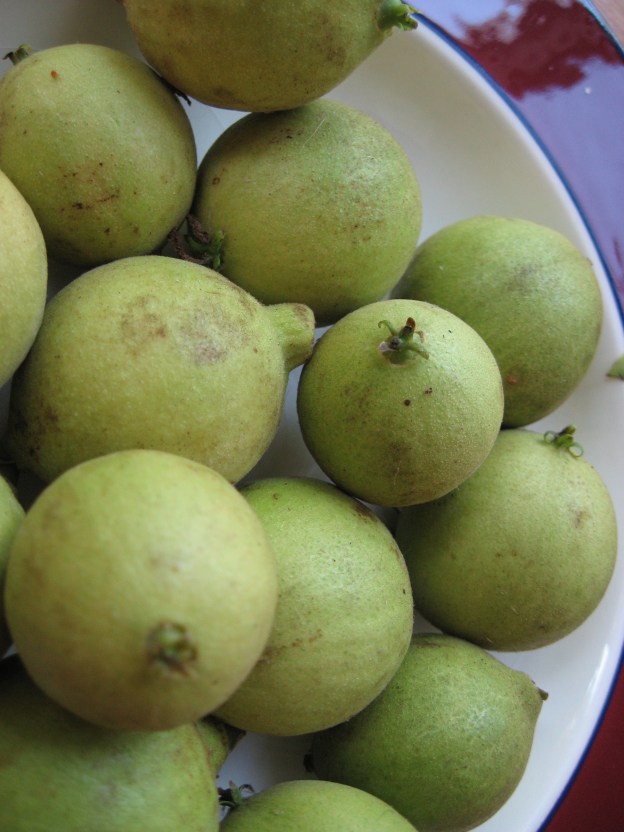
Walnuts may not seem like summer fruits, but they are – as long as you have the right recipe.  Katherine takes you to the heart of French walnut country for green walnut season.

France 1154 Eng newAnnotation fullRes 2

Public domain, via wikimedia commons

English walnuts do not come from England. The English walnut came to American shores from England, but the English got them from the French. The (now) French adopted walnut cultivation from the Romans two millennia ago, back when they were still citizens of Gallia Aquitania. Some people call this common walnut species “Persian walnut,” a slightly better name, as it does seem to have evolved originally somewhere east of the Mediterranean. But the most accurate name for the common walnut is Juglans regia, which means something like “Jove’s kingly nuts.” I think of them as queenly nuts, in honor of Eleanor of Aquitaine, because if any queen had nuts, she certainly did. During her lifetime the Aquitaine region of France became a major exporter of walnuts and walnut oil to northern Europe, and it remains so more than 800 years later. Continue reading

An apple for the teacher

With her fellow educators in mind, Katherine tells a story of virtual botany in the dining hall and letting students be teachers.

When we botanists in the kitchen are quiet for a little while, it usually means we are focusing all of our attention on our day jobs.  Like a garden, the academic calendar has a rhythm that cannot be ignored, and from April through June, I pour most of my time and creative energy into my small seminar class, where we dig into the evolutionary and ecological connections between humans and plants across many time scales and topics. It’s a fun class and the debate is usually lively, but because the journal articles we discuss are often dense and technical, I sometimes worry that we are squelching some opportunities for joy. Continue reading

A biologist eating for two

This is a bit tangential to our usual fare, but I think it’s fun, and you may as well. A friend of mine, Cara Bertron, edits the creative and delightful quarterly compendium Pocket Guide. I submitted this image, entitled “A biologist eating for two,” for the current issue, which is themed “secret recipes.” It’s a cladogram of the phylogenetic relationships among all the (multicellular) organisms I (knowingly) ate when I was pregnant with my now two-year-old daughter. Continue reading

Going bananas

What can make me feel less guilty about buying bananas? Science.

DSC08488

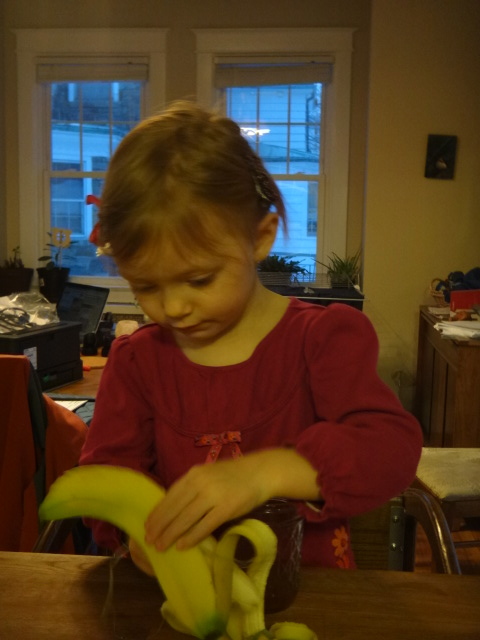
Trying to get the banana back in the peel

I am genuinely curious about the size of the fraction of carbon in my two-year-old that is derived from bananas. When we have bananas in the house, which is most of the time, she eats at least part of one every day. She loves them peeled, in smoothies, dried, in banana bread, or in these banana-rich cookies, which sound like they shouldn’t be good but are totally amazing. Bananas are inexpensive and delicious, and making nutritious food with them gives me a sense of parental accomplishment. Nonetheless, always I feel a niggling sense of guilt whenever I plunk a bunch of bananas into the shopping cart. Prosaic though it may be, most of this is contrition inspired by the “local food” movement. I know that very little is benign about the process responsible for bringing these highly perishable tropical fruits to my table for less than a dollar a pound. The remainder of my remorse is conviction that bananas should not be taken for granted. Not only is banana history and biology interesting, but the banana variety in our grocery stores, the Cavendish, is in danger of commercial extinction. There isn’t an easy solution to the problem or an obvious candidate for a replacement variety. The history of the Cavendish’s rise, and the biology behind its current peril, makes for a good story. Continue reading

Our Easter Bunny is a Botanist

Plant-dyed Easter eggs inspire a glimpse at the diversity of plant pigments.

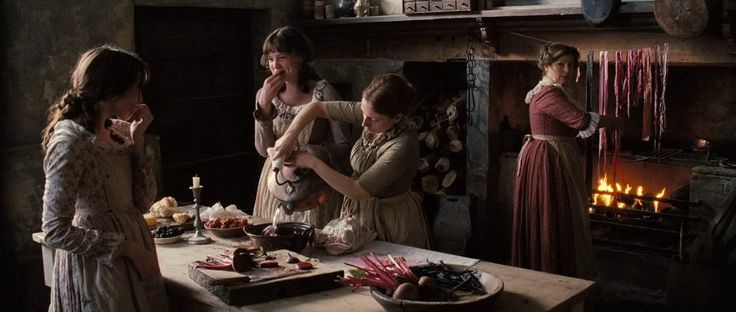
(scene from Pride and Prejudice of dying ribbons with beets: https://www.pinterest.com/pin/374150681515259286/)

(scene from Pride and Prejudice of dying ribbons with beets)

Pigments serve a variety of roles in plants. Many pigments have physiological roles within plants and protect plant tissues from sunburn and pathogens and herbivores (see review by Koes et al. 2005). Most noticeably, however, their brilliant colors attract animal pollinators to flowers and seed dispersers to fruit. Humans are also interested in plant pigments, in part because they color and sometimes flavor our food, are potentially medicinally active, and have been used as natural dyes and paints for millennia.

red cabbage

red cabbage

Last weekend I made some natural Easter egg dyes from turmeric and beets (I followed these instructions). We also considered making dyes from red and yellow onion skins or red cabbage, but we kept it simple. This handful of plants used to make cheap, easy, homemade dyes can give us some insight into of the chemical and evolutionary diversity of plant pigments. Continue reading

Origin stories: spices from the lowest branches of the tree

Why do so many rich tropical spices come from a few basal branches of the plant evolutionary tree?  Katherine looks to their ancestral roots and finds a cake recipe for the mesozoic diet.

I think it was the Basal Angiosperm Cake that established our friendship a decade ago.  Jeanne was the only student in my plant taxonomy class to appreciate the phylogeny-based cake I had made to mark the birthday of my co-teacher and colleague, Will Cornwell.  Although I am genuinely fond of Will, I confess to using his birthday as an excuse to play around with ingredients derived from the lowermost branches of the flowering plant evolutionary tree. The recipe wasn’t even pure, since I abandoned the phylogenetically apt avocado for a crowd-pleasing evolutionary new-comer, chocolate.  It also included flour and sugar, both monocots.  As flawed as it was, the cake episode showed that Jeanne and I share some unusual intellectual character states – synapomorphies of the brain – and it launched our botanical collaborations.

Branches at the base of the angiosperm tree
The basal angiosperms (broadly construed) are the groups that diverged from the rest of the flowering plants (angiosperms) relatively early in their evolution.  They give us the highly aromatic spices that inspired my cake – star anise, black pepper, bay leaf, cinnamon, and nutmeg.  They also include water lilies and some familiar tree species – magnolias, tulip tree (Liriodendron), bay laurels, avocado, pawpaw (Asimina), and sassafras. Continue reading

Let’s get it started with some black-eyed peas (and rice)

You don’t have to be superstitious to believe in the power of hoppin’ john on New Year’s Day.  Katherine’s recipe is below, but first, she takes this good excuse to talk about the structure of beans, the magical fruit (really seeds).

The magic of beans
Beans are extremely satisfying seeds.  They are large and germinate easily.  They can be harvested young and eaten soft – like limas, favas, and green peas – or in their fresh pods, like green beans and sugar snap peas.  They are most beautiful and useful when allowed to mature and dry naturally.  They are creamy white, chestnut, blue-black, or pink; mottled, speckled, cow-spotted, or black-eyed; fat and reniform, or shaped like a lens or a ram’s head.  They can weigh down pie crusts or fill bean bags.  Food co-ops everywhere are built on the cornerstones of bulk bins full of colorful dried beans.  Running your hands through a bowl of cool dried beans is an inexplicably simple joy. Continue reading

Hollies, Yerba maté, and the botany of caffeine

Yerba maté, the popular herbal tea from South America, is a species of holly. It’s also caffeinated, a characteristic shared by only a small number of other plants.

CRW_1675

English holly. Photo by K. Bills

Along with conifer trees and mistletoe, hollies are a botanical hallmark of the winter holiday season in Europe and the United States. Most hollies are dense evergreen shrubs or small trees and produce beautiful red fruits that stay on the plant through the cold winter months. Sprays of the dark green foliage grace festive decorations, and wild and cultivated hollies punctuate spare winter landscapes. Especially popular in winter, too, are warm beverages. One of the most popular, at least in South America but increasingly elsewhere, is yerba maté. It is a seasonally appropriate choice because the maté plant is a holly. Unlike the decorative hollies, usually American (Ilex opaca) or English (Ilex aquifolium) holly, maté (Ilex paraguariensis) is caffeinated. This puts it in rare company, not only among hollies, but among all plants. Continue reading

Cranberries, blueberries, and huckleberries, oh my! And lingonberries, billberries…

Flavorful and juicy thought it may be, Thanksgiving turkey, for me, is merely the vehicle for the real star of the meal: cranberry sauce. And cranberry is in the same genus as blueberries, lingonberries, huckleberries, and billberries. And they all make their own pectin. Let us give thanks this holiday season for Vaccinium.

Cranberry sauce is my favorite staple item at our big holiday dinners. Long-prized by indigenous North Americans, cranberries would have been in the diet of those Native Americans participating in the first Thanksgiving if not part of the meal itself. When the fresh cranberries hit the stores in late fall, we stock up. Cranberries, however, are not the only member of their genus that is perennially in our freezers or in our annual diet: blueberries, many huckleberries, lingonberries, and billberries are all in the large genus Vaccinium (family Ericaceae, order Ericales). Continue reading