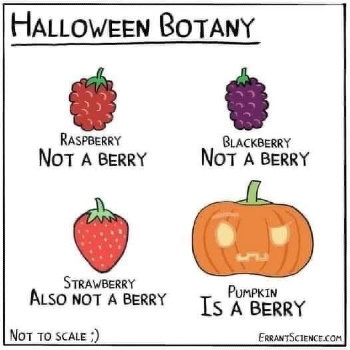
Pumpkins and other winter squashes are gloriously large fruits and are therefore excellent subjects for easy botanical observation. Carving a Jack-O-Lantern or cutting up a squash for a recipe becomes an instructive dissection when you know what to look for. We walk through the necessary information in this month’s Botany Lab of the Month. Before that we provide a brief overview of squash diversity in Food for Thought. We conclude with recent relevant media and journal articles in Gleanings and Baker’s Dozen. But, first, this cartoon from Errant Science that ties some of our summer newsletter topics to this one:
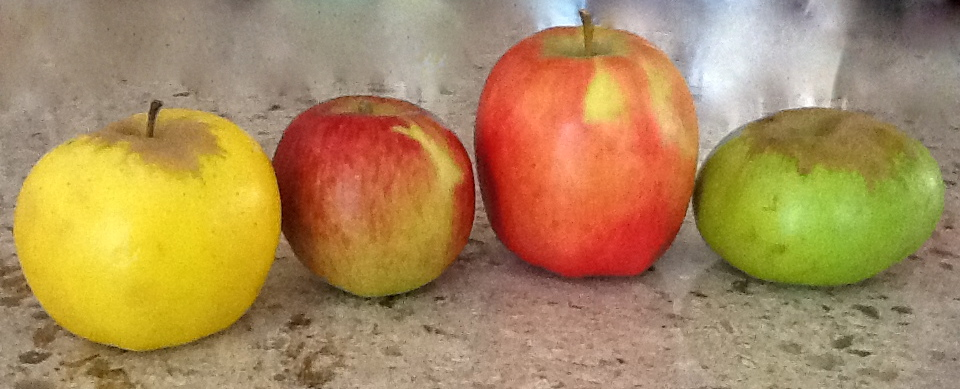
Strictly botanically speaking, a “berry” is just a fleshy fruit that arises from a flower with a single ovary. The cartoon hilariously illustrates that the colloquial use of “berry” sometimes clashes discordantly with the botanical definition. In casual speech, a berry is a smallish, juicy thing, regardless of how many ovaries the flower in question might have (raspberry and blackberry flowers have numerous ovaries, as we discussed in July’s newsletter), or whether a flower’s ovary was involved at all (the delicious part of a strawberry arises from the flower’s receptacle, not ovary, as we showed in June’s newsletter). Several fruits comfortably fit both definitions, such as blueberries (Vaccinium) and grapes (Vitis). Some botanical berries, though, like tomatoes and eggplants (Solanum), aren’t thought of as smallish and sweet. Squashes, cucumbers, and melons (and loofah!)–the cucurbits (family Cucurbitaceae)–are all pepos, a special type of berry. They develop from flowers with a single inferior ovary, surrounded by a protective hypanthium. The hypanthium fuses to the ovary wall to make the hard rind that surrounds the mature fruit (more on this below in Botany Lab of the Month). We showed in last month’s newsletter that apple flowers also have inferior ovaries. The apple hypanthium develops into delicious tissue instead of a hard rind, making apples pomes, not pepos.
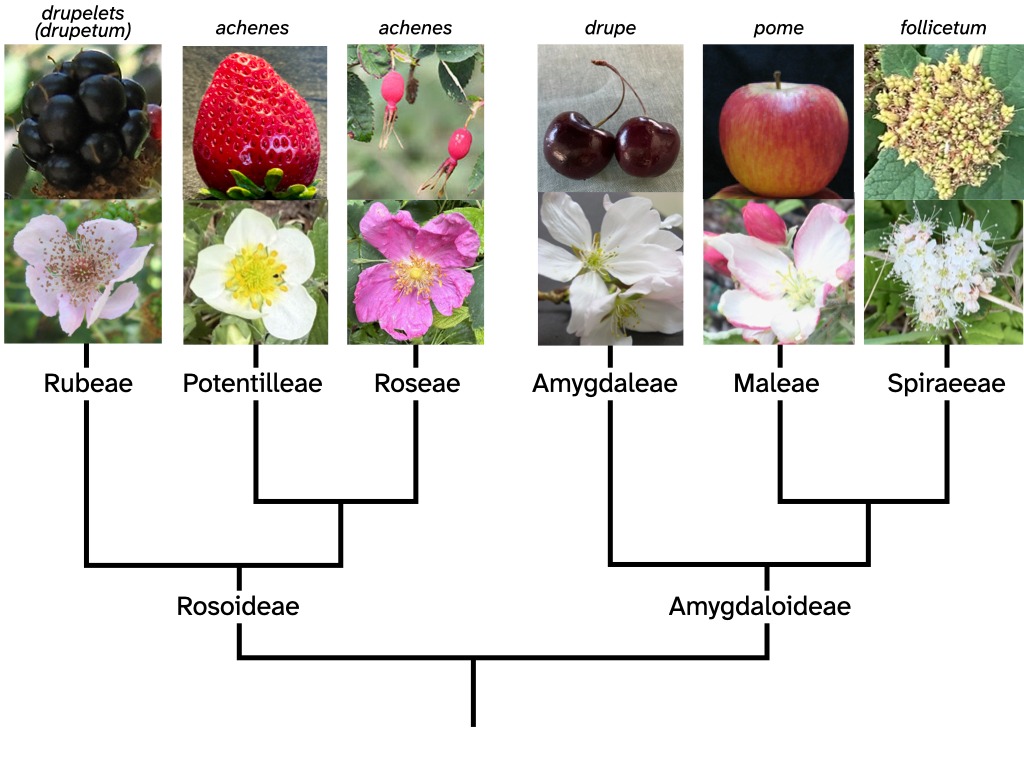
Apples, those iconic harbingers of autumn, are the perfect subject for the conclusion of our summertime interrogation of the rose family (the Rosaceae). If you read our earlier newsletters featuring strawberries, brambles, and stone fruits, then our image (below) of the phylogenetic relationships among important subgroups in the Rosaceae will be familiar to you. Apples are the flagship genus (Malus) of the Maleae tribe (pronounced “mal-ee-ay”). The Maleae also includes pears, quinces, serviceberries, loquats, rowan, medlar, and hawthorns. We will obviously have to return to the Maleae in future newsletters to give all those fabulous fruits their due consideration (In the meantime, revisit Katherine’s beautiful essay “Pear grit and the art of aging”). The fruit structure of all of them is called a pome. We get poetical about pomes in Botany Lab of the Month, where we cut up apples. Before that, we talk about apple evolution in Food for Thought. We conclude, as always, with our roundup of recent media and journal articles in Gleanings and Baker’s Dozen.
Relationships among the major subgroups of the Rosaceae. The third subfamily (Dryadoideae) is not shown. Images of flowers and fruit from one food species from each tribe are shown, with the botanical name of each fruit type labeled above the images.
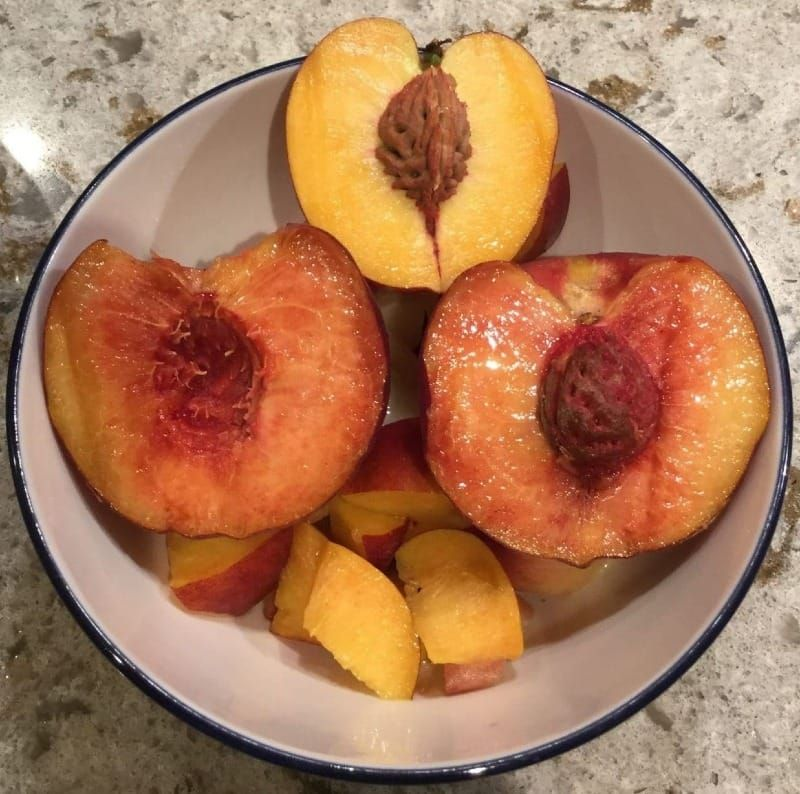
Does the summer heat have you feeling drupey? Last month we broke down brambles for you, showing that their “berries” were really aggregates of drupelets. This month in Food for Thought we take on full-sized drupes––peaches, nectarines, cherries, apricots, and almonds. Yes, we know that the peak of peach season has come and gone. But now is the best time to grab the last of the market’s peaches, in anticipation of cooler days when you might appreciate a little burst of summer on your toast. We do just that in the Botany Lab of the Month, where we combine our favorite rose family drupes with fresh mint from the garden to make a jam so sweet and rich that it tastes like justice itself. Mmmmmm…peach-mint jam.
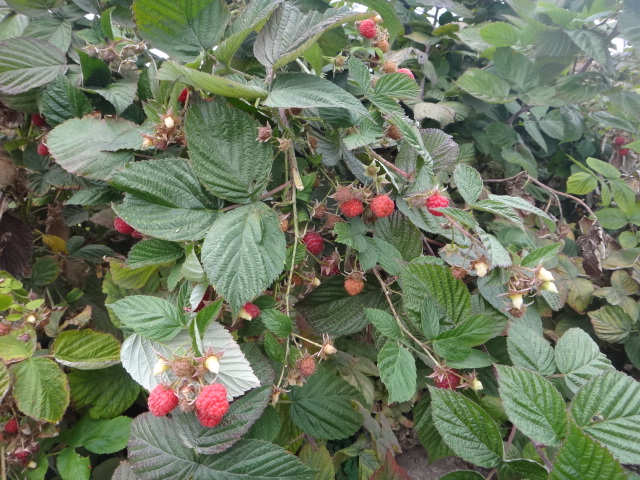
This month we continue our summer romance with the rose family, specifically the cane fruits, or brambles, which include blackberries, raspberries, and their many look-alikes. These cane fruits belong to the branch of the rose family called the Rosoideae, which also includes roses and strawberries. Although these “fruits” are superficially very different, they are all built on the same basic structure: a single flower produces a great many pistils with separate ovaries, each of which becomes a fruit. The many fruits within a flower are then packaged together into a colorful flavorfest of a structure that some people, birds, and mammals like to eat. Ecologically and culinarily they function as a single fruitlike unit, and we casually call them berries (or hips, in the case of roses). But as we saw in June’s newsletter (link), strawberries are not berries at all. They are big fleshy red receptacles covered in small dry achene-type fruits. Rose hips are a bit like inside-out strawberries: their achenes are enclosed by a hollow red shell derived from the hypanthium and other floral parts. In Food for Thought: A ramble through the brambles we compare cane fruits and strawberries, which are very similar, except that cane fruits have invested their bright sweet fleshiness into their fruits instead of their receptacles.
The brambles bring into play another prominent aspect of some of our favorite plants from the rose family: spinescence, including prickles, spines, and thorns. Each of these sharp projections is morphologically and developmentally distinct, and the rose family boasts numerous examples. We break it down in Botany Lab of the Month: Be careful. She’s sharp.
We conclude this month’s newsletter with a selection of relevant media and journal articles in Gleanings and Baker’s Dozen.
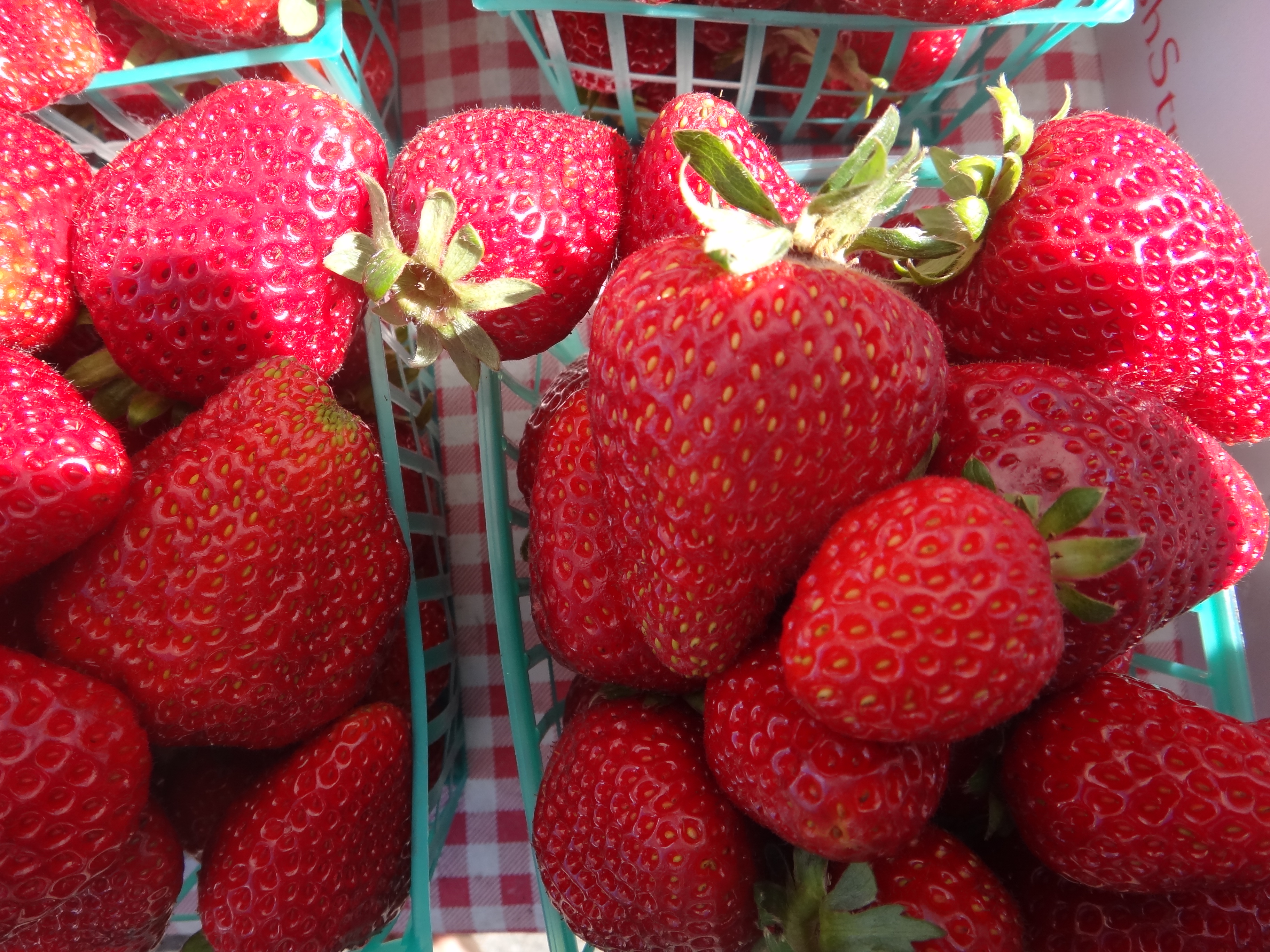
With so many strawberries in so many kitchens this month, now is the perfect time to merge botany lab and breakfast preparation by working through the many parts of a strawberry. We kick off the strawberry love with some explanations in Food for Thought. You can learn quite a bit about flowers by cutting up a strawberry, as we do in this month’s Botany Lab of the Month. As it turns out, this enigmatic little gem is packed with coincidences and apocrypha along with its citric acid and anthocyanins. We conclude with recent relevant media and journal articles in Gleanings and Baker’s Dozen.
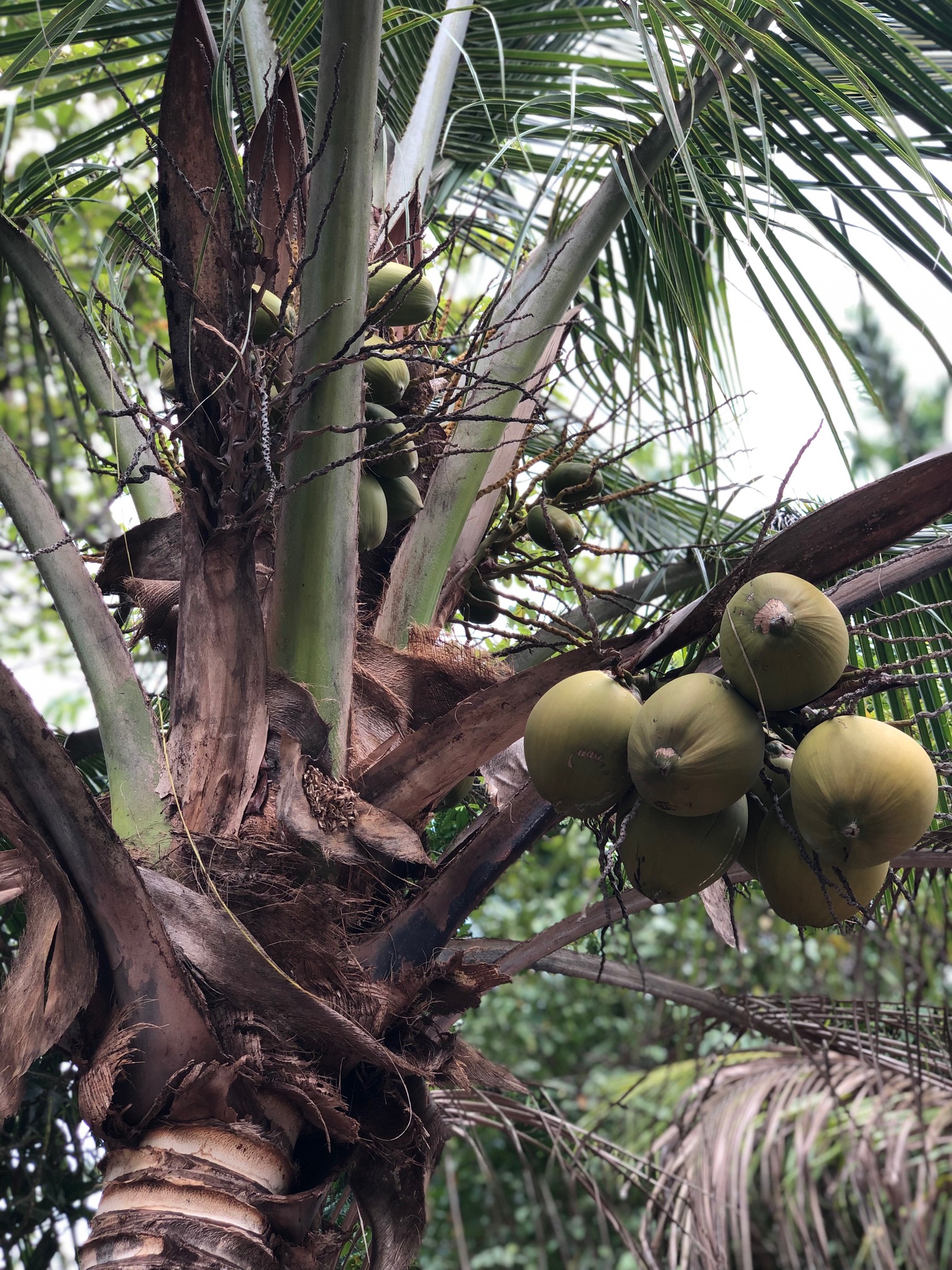
Developing coconuts, in Panama. Photo by J. Touchton
The May 2026 issue of our Gather and Sow newsletter is out.
Coconut palms grow some of the biggest seeds on the planet, and vanilla seeds, from an orchid, are among the smallest. They are both delicious! They are also the subjects of this month’s newsletter. Just in time for Mother’s Day (May 10th this year), in this month’s Food for Thought essay (“Coconuts for Mother’s Day”), we make the case that Mother’s Day celebrations should include more coconut. The large seed size of coconuts, and the small size of orchid seeds, are indicative of their respective parenting philosophy. In this month’s Botany Lab of the Month we describe coconut and vanilla fruit and seed morphology in the course of making cookies (“Extreme Monocot Cookies”). The newsletter concludes with Gleanings and Baker’s Dozen, our roundup of relevant recent media and journal articles.
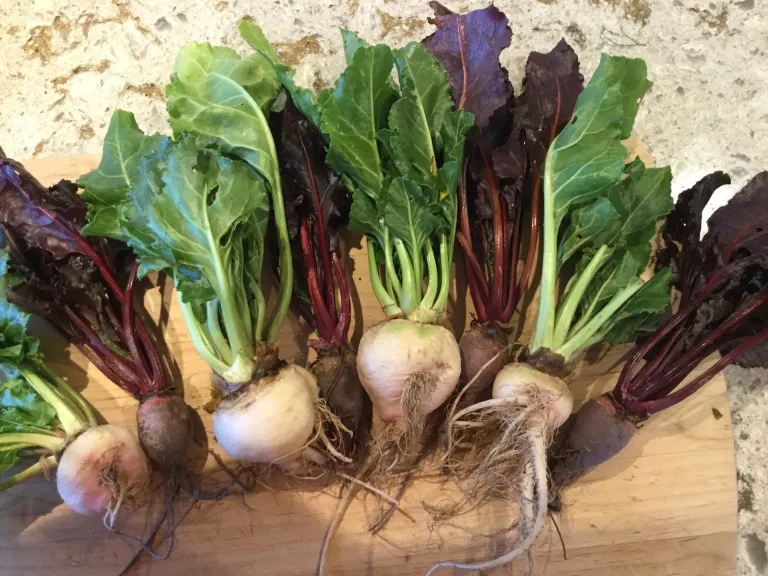
The Gather and Sow: April 2026 newsletter is out, just in time for Easter. We write about betalains, the pigments that impart brilliant colors to beets and their relatives. And we dye Easter eggs with plant dyes, make violet syrup, and learn about pH.
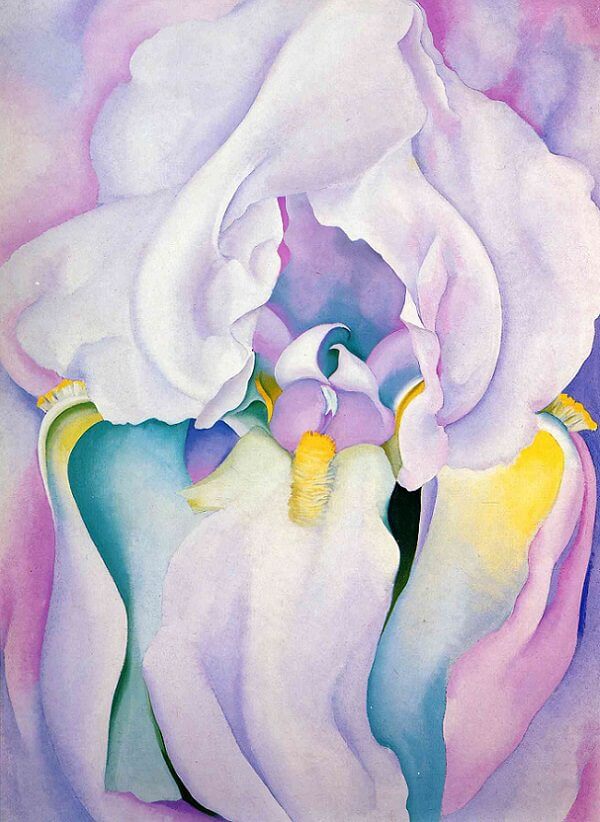
“Light Iris” by Georgia O’Keefe (1924). You don’t have to seek out a Georgia O’Keefe painting to see giant flower parts from the iris family (Iridaceae). Just look in your spice cabinet. The spice saffron is the dried stigmas from the flowers of the saffron crocus (Crocus sativus), also in the iris family. We explore the botany of saffron and corn silks in this month’s Botany Lab of the Month feature.
Leeks are a traditional symbol of St. David’s Day, and their morphology is the topic of this issue’s Food for Thought: Ay, leeks is good!
Women’s history month is a time to recognize the contributions of women to American history, society, and culture. Too often women’s accomplishments have gone unsung. The same is true for the “female” parts of flowers. We rectify this by celebrating extraordinary flower parts in corn and the saffron crocus. All celebrations deserve cake, and we offer a recipe for one that combines corn and saffron in this month’s Botany Lab of the Month: Honoring female (plant) anatomy with saffron polenta cake.
We conclude with research and media highlights in Baker’s Dozen and Gleanings. Alongside several recent research articles, we have included a few classic papers by two matriarchs of plant biology, Katherine Esau and Barbara McClintock, in honor of Women’s History Month.
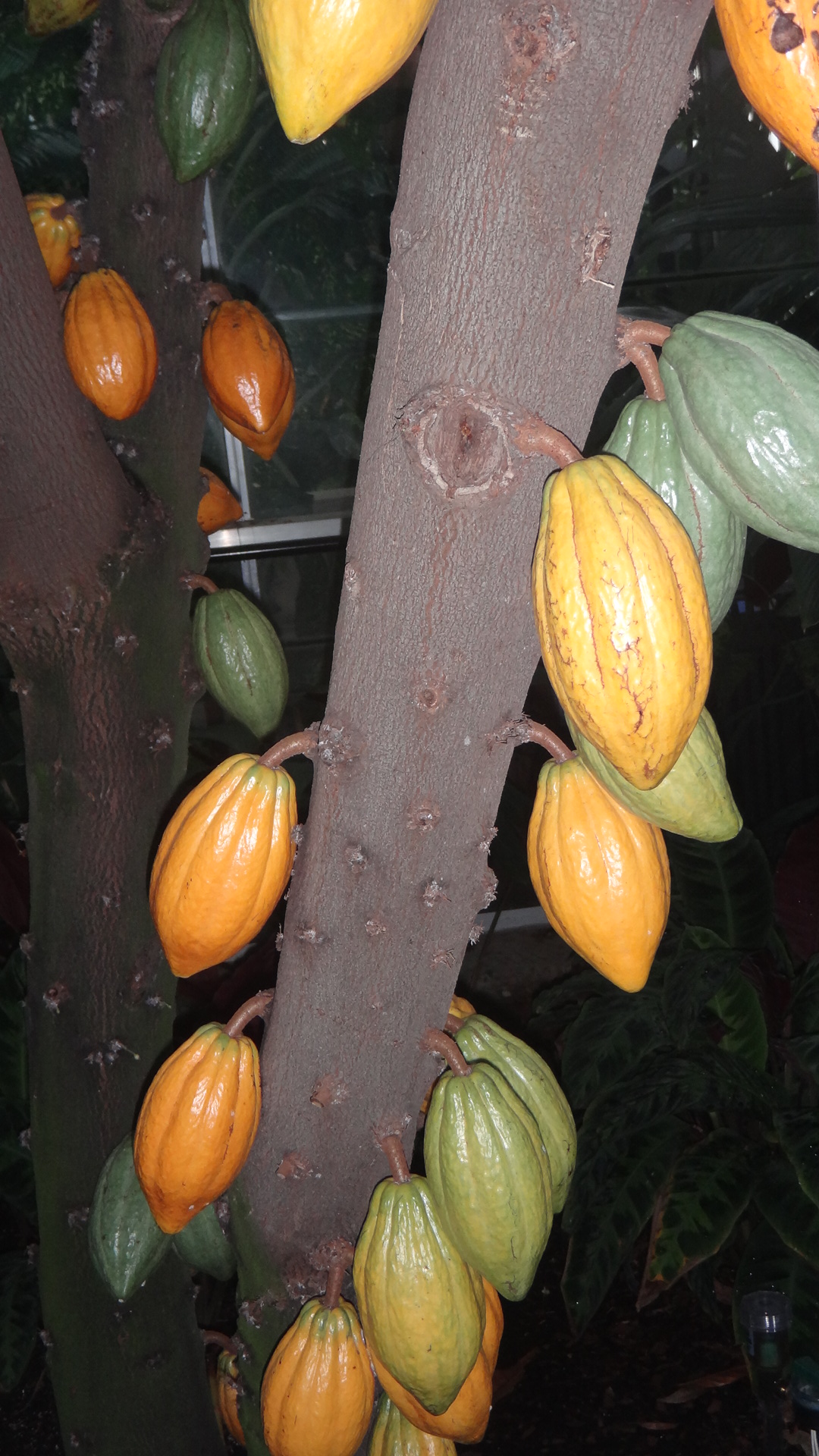
Cauliflorous fruits on a cacao tree (Theobroma cacao), in a glasshouse at the United States Botanic Garden.
We intend to post new issues of Gather and Sow every month. Content here on the blog will generally remain available. We remain dedicated to illuminating the fascinating biology of our food plants.
Each issue of Gather and Sow will feature three components:
Food for Thought: an essay, possibly seasonal or inspired by current events
Botany Lab of the Month: a botany lesson for the hands-on learner, packaged as an activity or recipe designed for the home kitchen
Baker’s Dozen and Gleanings: We highlight thirteen-ish recent research articles and other relevant media, respectively, that further our understanding of the biology of our food plants.
FAQ: Aren’t you two writing a book? Is it done yet? Yes, we are writing The Botanist in the Kitchen book. No, it is not done yet. We have an agent (Hi Lucy!). And a book proposal document. We are close to being done with our sample chapters. Hopefully a publisher will take interest very soon. We’ll post updates with the newsletters.
We would love to hear from you.
You can subscribe to Gather and Sow from theGhost site. We will also publicize newsletters here on the blog and on social media (Bluesky, Facebook). Please email us at botanistinthekitchen@gmail.com.
A Seminole pumpkin in my garden near DC, a decade ago
A Seminole pumpkin in a CSA box a decade ago got me thinking about squash diversity. Market bins and seasonal displays that autumn overflowed with squashes, gourds, and pumpkins in a dizzying array of sizes, shapes, and colors, but I had never seen a Seminole pumpkin among them. My pumpkin was squat, round, and the size of a cantaloupe. Its smooth, matte tan skin exactly matched the exterior of a butternut squash. The dense, dark orange flesh in its interior matched, too. It turns out that there is a good reason for this similarity: butternut squashes and Seminole pumpkins are different varieties of the same species, Cucurbita moschata. The pureed squash inside a can of commercially canned pumpkin is yet another variety of C. moschata, the Dickinson pumpkin, developed in the early 1800s by a Kentucky farmer named Elijah Dickinson. C. moschata boasts numerous other varieties, names of which variously include “squash” or “pumpkin”, but it is rarely the most well represented squash species at the market. That honor usually goes to Cucurbita pepo, followed closely by Cucurbita maxima, two of the five species of Cucurbita whose fruits appear on our tables as tender-skinned summer squashes or hard-shelled winter squashes.
Squash origins
All Cucurbita species are native to the Americas, a dozen or so species with scattered wild distributions, mostly in Mexico. Cucurbita fruits were important dietary staples for indigenous peoples from Central America to New England. Domestication of at least five Cucurbita species predated European exploration of the Americas by several thousand years. C. pepo may have been domesticated in Mexico by ten thousand years ago, around the same time that wheat was domesticated in the Mediterranean.
The word “squash” is derived from askutasquash, meaning “that which is eaten raw or uncooked” in the Algonquian language Narragansett, spoken by some indigenous groups of northeastern North America. It may seem surprising to think of winter squash as raw or uncooked, but drying strips of the raw fruit was a common means of traditional preparation and preservation throughout the Americas. The Massachusett and Wampanoag peoples of New England had an additional word, pôhpukun, to describe the squashes they grew that “grow forth round.” This word was transmogrified into “pumpkin” by the 17th-century English colonists made famous by tales of the first Thanksgiving. The indigenous word was conveniently similar to the Early Modern English word for Eurasian melon, pompion, which was familiar to Europeans of the period.
Sugar pumpkins (C. pepo) in a market
C. moschata proved particularly hardy in the swampy lands of what is now the southeastern United States, traditionally home to numerous tribes, including the Seminole. The squash that now bears their name grows as a sprawling plant with the huge palmate leaves and curling tendrils typical of cucurbits, members of the gourd family (Cucurbitaceae), which also includes cucumbers, melons, and gourds (and loofah!). Accounts of early Spanish explorers to Florida describe Cucurbita vines twining up tree trunks, with their pendulous fruits hanging over rivers or decorating the dead oaks that the Native Americans used as trellises to farm the squashes. The large nutritious seeds inside the fruit were as important a food source as the sweet flesh. Unsliced fruit could be stored for months, protected by the hard outer shell.
Seminole pumpkin (C. moschata) vining up my house
Squash hardiness is usurprising given the means by which cucurbit lineages initially arrived in the Americas. The family Cucurbitaceae arose near modern-day India in the late Cretaceous, around 63 million years ago. The leading hypothesis for how ancient cucurbits migrated from the Asian subcontinent to every other continent except Antarctica is transoceanic long-distance dispersal. That is, either the tough-shelled fruits floated across the ocean, or the seeds were carried in the guts of birds. Ancestral cucurbits made the journey from Asia to Africa, and then from Africa to South America. The jump from Africa to South America happened approximately five times over the course of several million years. The descendants of those five founders eventually radiated into around 350 modern cucurbit species in the Americas. The genus Cucurbita originated between 9 and 23 million years ago in Central or South America. Cucurbita expanded its range into North America by the onset of indigenous American agriculture, around 10,000 years ago.
Five species, many varieties
Butternuts (C. moschata) in a market
Those northern radiations of the genus resulted in the three highly variable species that constitute the vast majority of pumpkins and other squash consumed in the world: Cucurbita pepo, C. moschata, and C. maxima. Two additional Cucurbita species, C. argyrosperma (cushaw) and C. ficifolia (fig-leaf gourd), are cultivated in a few areas, mostly in Mexico and Central America. Most of the squashes that come to mind when you think of “pumpkin”—large Jack-O-Lantern pumpkins, orange sugar pumpkins, squat mini pumpkins, giant pumpkins, white Casper pumpkins—are varieties of Cucurbita pepo. C. pepo also includes acorn squash, delicata, stringy spaghetti squash, and most of the summer squashes—zucchini, yellow crookneck, pattypans, and marrows. C. maxima includes the hubbard, turban, and kabocha squashes. Distinct named cultivars of these Cucurbita squash species have been developed through selective breeding over centuries, and most are totally interfertile within a species, and the species do occasionally hybridize.
Summer squash cultivars–especially the zucchini, yellow crookneck, and vegetable marrow cultivars of C. pepo–have been developed for their tender, immature fruit. These fruits are meant to be picked well before seed maturation. If left on the plant to mature, summer squashes will develop the hard rind and woody seeds that characterize their winter squash brethren. European explorers introduced hard-shelled American Cucurbita to the rest of the world starting in the early 16th century, and the agricultural development of summer squashes occurred primarily in Europe subsequently. Most squash varieties, however, have been developed under selection for various characteristics of the mature fruit. At least one variety in Mexico was developed primarily for the mature seeds—pepitas—a staple of Oaxacan cuisine.
Much is known of the genetic basis of the tremendous morphological variation among Cucurbita species. We largely understand the genetic architecture of fruit shape, shell lignification (becoming hard and woody), color, size, and beta carotene content (carotenes—Vitamin A precursors—make the fruit of most winter squashes yellow to orange). A white pumpkin, for example, expresses dominant alleles (gene variants) of two genes: Wf for white flesh and W for weak fruit color. A warty pumpkin has a dominant allele of the gene Wt. The traditional orange pumpkin has the right alleles for many genes responsible for the synthesis of orange carotenoid pigments, especially lutein and beta-carotene, and the “orange” gene Or encodes an enzyme that directs the differentiation of specialized plastids in fruit cells called chromoplasts in which those carotenoids accumulate.
Summer squashes (C. pepo)
A particularly interesting gene unique to C. pepo called sp controls the stringiness of the fruit. When a hapless C. pepo inherits two copies of the recessive allele (gene variant) of the sp gene from its parents, the fruit flesh will have “spaghetti” texture, breaking into long strands when cooked. Hence, the name for “spaghetti squash” or “vegetable spaghetti.” Anatomically the strings are separated by bands of pectin that disintegrate during cooking. As cultivars of C. pepo, Jack-O-Lantern pumpkins, acorn squash, and over-ripe zucchini can also be stringy. If you cook up your Jack-O-Lantern pumpkins after Halloween, you might have to put the flesh through the blender to puree the strings. The flesh of C. maxima and C. moschata tends to be firmer than that of C. pepo, and it cooks up smoother. This is undoubtedly why C. moschata is preferred as the “pumpkin” of choice for commercial canned pumpkin producers, and why I prefer C. moschata or C. maxima varieties for any recipe that calls for pureed squash, be it ravioli or pumpkin pie.
Turning pumpkin carving into a botany lab
Amish pie pumpkin, a large and delicious variety of hubbard squash, Cucurbita maxima. That’s a 12-inch chef’s knife for scale.
Winter squashes are gloriously large fruits and are therefore excellent subjects for botanical observation. Carving a Jack-O-Lantern or cutting up a squash for a recipe becomes an instructive dissection when you know what to look for.
Botanists have names for different types of fruits. A squash is a pepo, a hard-rinded berry that develops from a flower with a single inferior ovary. “Inferior” means that the squash flower ovary is located within the hypanthium, the tissue that supports the petals and sepals. Squash plants make separate male and female flowers. Upon opening, the golden petals of female flowers are already subtended by a tiny squash—the inferior ovary and its protective tissue. The round brown circle on what we perceive to be the bottom of the pumpkin is the scar left after the petals and sepals fell off the developing fruit. As the fruit develops, the hypanthium tissue fuses with the outer wall of the ovary to become the exocarp rind, encasing the firm flesh of the mesocarp and soft endocarp. When you scoop out the stringy, gooey stuff and seeds from inside the pumpkin, you’re scraping out both the endocarp and the placental tissue that that connects the seeds to the ovary wall. The cavity of your pumpkin might look like it has lobes to it, called locules. I start the pumpkin carving by cutting out the lid around the “handle,” which is really the peduncle, the specialized stem that connects first the flower and then the developing fruit to the main plant stem.
Save the seeds! It’s a bit of a pain to separate the gooey fruit from the seeds, but salted and roasted pumpkin seeds is a real treat. Crack the hard seed coat (testa or integument) to reveal the olive-green-colored cotyledons (leaves) of the embryo, which take up most of the seed. The part of the embryo that will sprout roots is in the pointy end of the teardrop-shaped seed.
Seeds of ancestral Cucurbita species are present in fossilized mastodon dung deposits, which suggests that fruits of the genus were already adapted to dispersal by large mammals even before humans got involved with its evolution through domestication. There is evidence that some ancient Cucurbita species declined in geographic extent and abundance following the extinction of the animals that had pushed the evolution of its fruits toward large size and high sugar content. Humans arriving in the Americas essentially replaced the extinct megafauna and fundamentally changed the trajectory of the languishing Cucurbita, which in turn eventually became a crucial food source for the indigenous peoples of two continents.
I find this long view of the history of these plants and people to be a hopeful tale. It is as good an accompaniment to a Thanksgiving pumpkin pie as the whipped cream.