Category Archives: Uncategorized

Cranberries, blueberries, and huckleberries, oh my! And lingonberries, billberries…

Flavorful and juicy thought it may be, Thanksgiving turkey, for me, is merely the vehicle for the real star of the meal: cranberry sauce. And cranberry is in the same genus as blueberries, lingonberries, huckleberries, and billberries. And they all make their own pectin. Let us give thanks this holiday season for Vaccinium.

Cranberry sauce is my favorite staple item at our big holiday dinners. Long-prized by indigenous North Americans, cranberries would have been in the diet of those Native Americans participating in the first Thanksgiving if not part of the meal itself. When the fresh cranberries hit the stores in late fall, we stock up. Cranberries, however, are not the only member of their genus that is perennially in our freezers or in our annual diet: blueberries, many huckleberries, lingonberries, and billberries are all in the large genus Vaccinium (family Ericaceae, order Ericales). Continue reading

Nasturtiums and the birds and the bees

Hummingbirds and ancient bees are responsible for the color and shape of nasturtium blossoms and have a unique view of them, explains Jeanne over salad. 

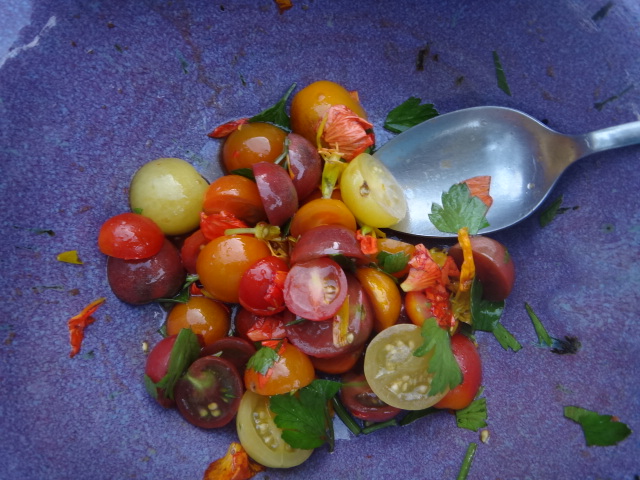
Nasturtium flowers cut into tomato salad with parsley

Nasturtium flowers cut into tomato salad with parsley

Fall frost hasn’t yet claimed our nasturtiums (Tropaeolum majus; Tropaeolaceae family). The large, colorful blooms amidst the round leaves are still spilling over planting boxes.  All parts of the plant are edible and boast spicy mustard oil glucosinolates, betraying the plant’s membership in the order Brassicales, along with the cruciferous vegetables and mustard in the Brassicaceae family, capers (Capparaceae), and papaya (Caricaceae; try the seeds, as suggested here). I’ve heard that the immature flower buds and immature seed pods can be pickled like capers, but I haven’t tried it yet. Mostly I use the flowers, throwing a few in a salad or chopping them coarsely with other herbs and stirring them into strained yogurt or butter to put on top of roasted vegetables or lentils. In addition to the mustardy kick, the sweet flower nectar adds to these dishes. Continue reading

Okra – what’s not to like?

What is hairy, green, full of slime, and delicious covered in chocolate? It has to be okra, bhindi, gumbo, Abelmoschus esculentus, the edible parent of musk. Katherine explores okra structure, its kinship with chocolate, and especially its slippery nature. What’s not to like?

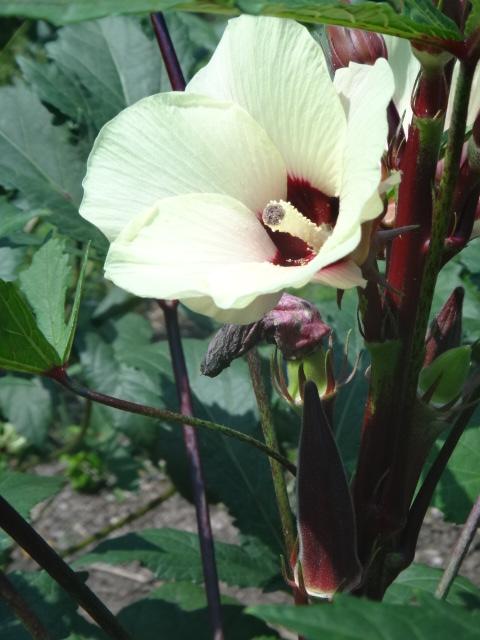
Okra flower with red fruit below

Okra flower with red fruit below

People often ask me about okra slime. Rarely do they ask for a good chocolate and okra recipe, which I will share unbidden. With or without the chocolate, though, okra is a tasty vegetable. The fruits can be fried, pickled, roasted, sautéed, and stewed. Young leaves are also edible, although I have never tried them and have no recipes. Okra fruits are low in calories and glycemic index and high in vitamin C, fiber, and minerals. The plant grows vigorously and quickly in hot climates, producing large and lovely cream colored flowers with red centers and imbricate petals. The bright green or rich burgundy young fruits are covered in soft hairs. When they are sliced raw, they look like intricate lace doilies. In stews, the slices look coarser, like wagon wheels. And yes, okra is slimy. And it is in the mallow family (Malvaceae), along with cotton, hibiscus, durian fruit, and chocolate. Continue reading

Figs and Mulberries, inside and out

A shorter version of this essay appears in the Autumn 2013 issue of the beautiful, creative online magazine Soiled and Seeded.  Here Katherine and Jeanne explain the topological relationship between figs and mulberries and do a little investigative journalism.

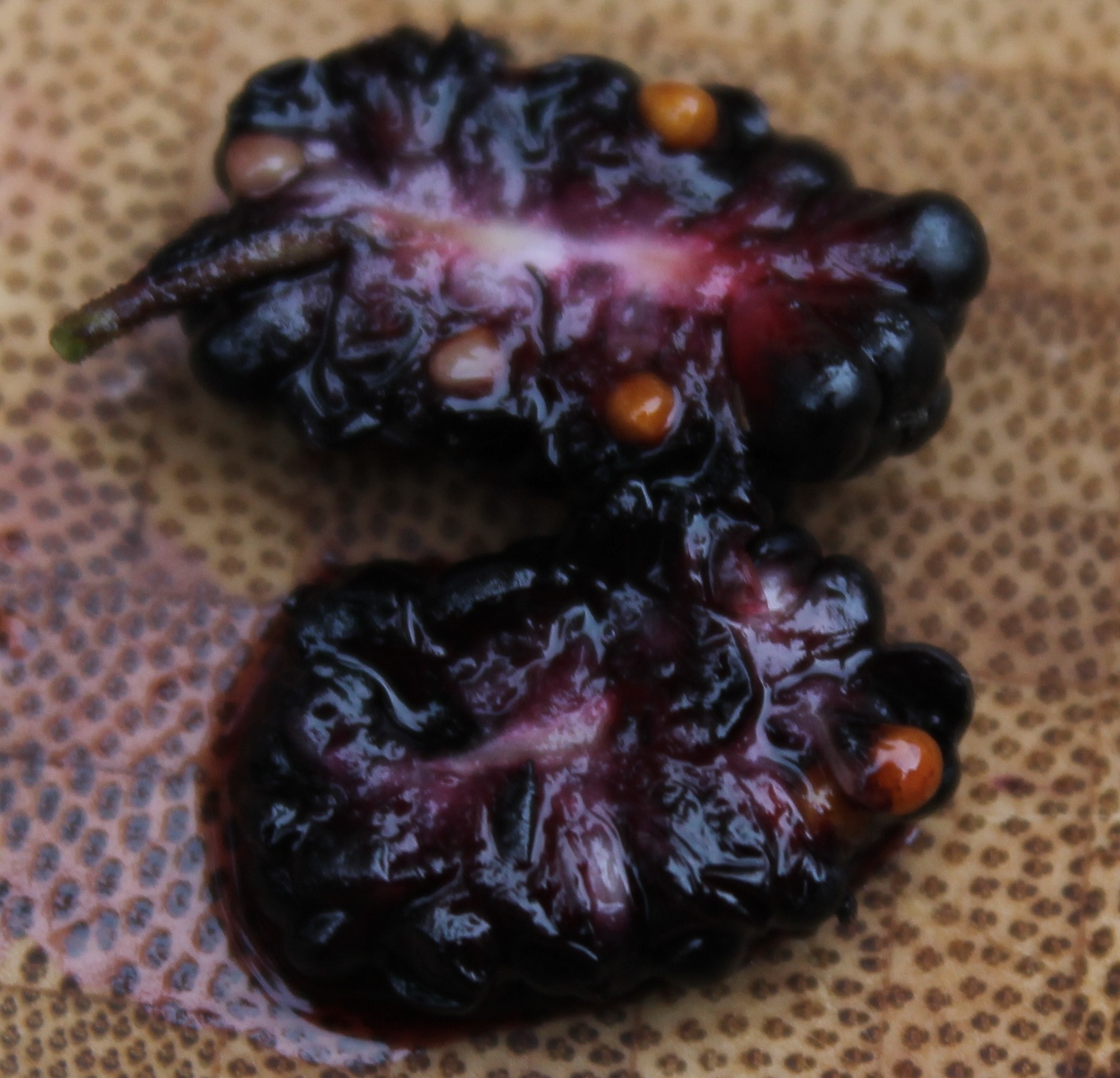
Mulberries

Mulberries

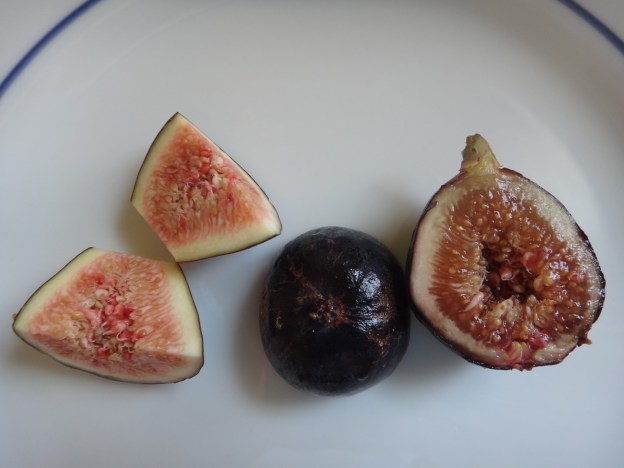
Figs and mulberries are both gorgeous, sexy fruits, but in very different ways. At first blush a mulberry could be the fragile hot-mess cousin of a blackberry, while figs are classically sensual fruits, like marble nudes teetering on the edge of vulgar. For all their fleshy assertiveness, both fruits keep their secrets; and it takes more than a long, intense gaze to uncover their close relationship and know what makes them sweet.  Mulberries may look like blackberries (and share a taxonomic order), but they are built from different plant components. The true siblings are mulberries and figs (both in family Moraceae), and at heart they are very much alike, although figs are clearly the more introverted of the two. Continue reading

Making ratatouille like a botanist

The story of the nightshades is usually told as a tale of European explorers, New World agriculturalists, and a wary bunch of Old World eaters.  But what about the birds?  And the goji berries?  Jeanne and Katherine introduce you to the Solanaceae family and walk you through the botany to be observed while making ratatouille, the classic French collision of Eastern and Western nightshades.

Can you imagine Italian cuisine without tomatoes? The Irish without potatoes? Chinese cuisine without spicy, fruity chiles?  Such was the case prior to the discovery of the New World nightshades (family Solanaceae) by sixteenth-century Spanish explorers.  And they couldn’t help but run into them.  Solanaceae is a huge family, with over 100 genera and nearly 2500 species, most of which are in Central and South America. Continue reading

Pear grit and the art of aging

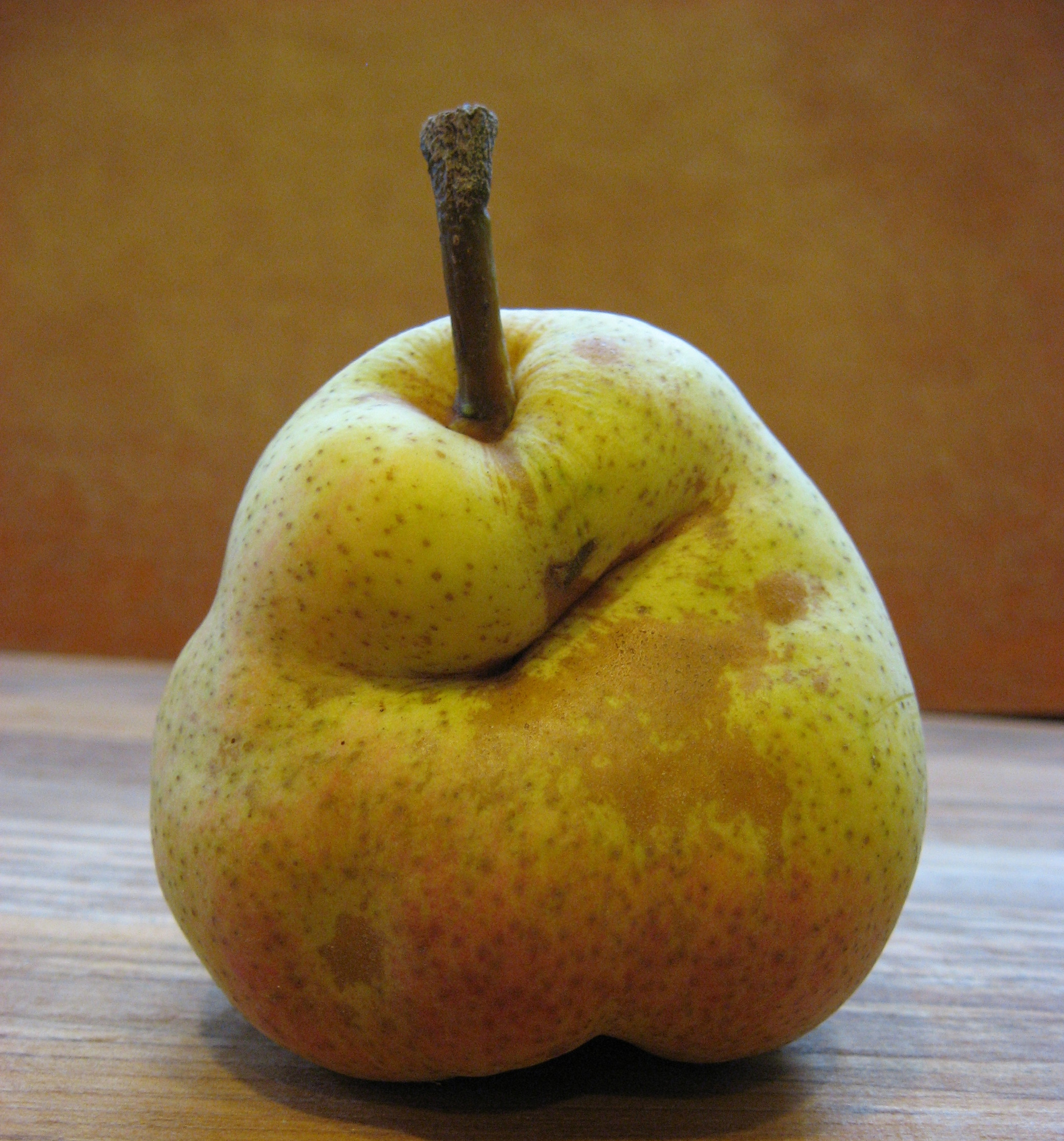
Nostalgia emanates from a basket of pears, inspiring Katherine to explain what makes up these glorious, gritty, and gorgeous late-summer fruits.

Last week a dear friend conjured an entire autumn for me when she handed me one of her pears.  She had picked it a few days prior from one of the small espaliered trees that guard the outside of her bedroom wall and overlook her garden.  It was pale buttery gold with a pink blush, soft and honey-flavored.  A month past the solstice, we were still able to enjoy the low sun well into early evening as we sat on her deck and gazed over the garden, savoring the fruit.Rosaceae talking pear
Bartlett pears, like my friend’s, ripen in the summer and yet they herald the fall.  They appear, and we start the inevitable tumble towards apples, wool socks, and the bittersweet baseball postseason.  Other popular varieties, such as Bosc and d’Anjou, tend to arrive later, when we have already come to terms with shorter cooler days.

I love apples, but they are not as emotion-laden for me.  Whereas apples seem timeless, even summer pears carry an old fashioned patina.  They evoke a time when canning was a skill necessitated by the Depression, but which still made a lot of good sense.  My grandmother must have spent a thousand hours canning the soft sweet pears from her trees.

Pears also know how to age right.  Apples are harvested ripe from the tree, but pears should be taken when they have reached their full size and before they are ripe.  My friend always picks her pears before the squirrels can mark them with bite-sized divots, a practice that also happens to keep them from becoming mealy on the tree.  She sent me home that day with a bag of firm green Bartletts and instructions to hold them in a bag in my kitchen for a couple of days.  Summer varieties don’t require chilling, but d’Anjou and Comice pears benefit from a month of nearly freezing temperatures, followed by ripening at room temperature (Stebbins et al).  The proper aging of pears is all about managing the activity of enzymes that alter various compounds and break down cell walls.  Such treatment would ruin high-maintenance peaches, which are horrified by the thought of getting old and don’t take well to chilling. Continue reading

Super styled

Corn silks are annoying, but they’re also amazing. The longest styles on the planet don’t make it easy for corn pollen to do its job.  Gain new respect for your corn on the cob. 

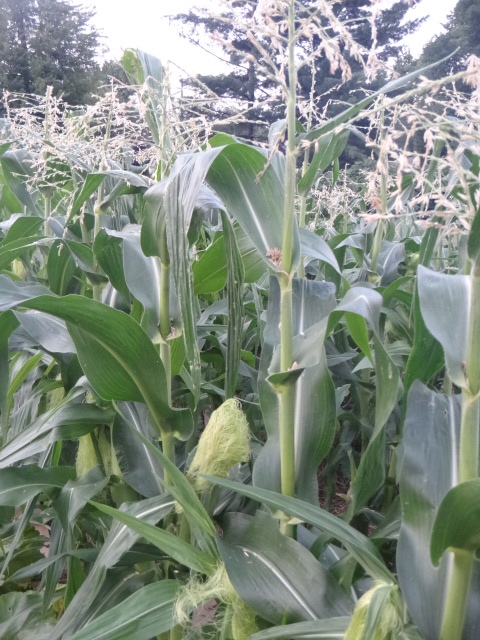
Corn plant. Tassels with male flowers on top, ears with exposed silks in the middle

Corn plant. Tassels with male flowers on top, ears with exposed silks in the middle

Fresh corn (Zea mays, Poeaceae) is a summertime treat. Shucking corn silks, though, can be a pain.  Corn silks, however, are amazing, and maybe knowing why will ameliorate their annoyingness.  Formally corn silks are the style, the part of the female flower that intercepts pollen.  Female flowers of many species have a stigma, a sticky pad, atop their styles to intercept pollen, but corn silks are lined with sticky trichomes (like hairs) that essentially do the same thing.  Corn silks are incredibly long styles.  Can you think of another plant with a flower appendage that could rival it?  I can’t.  Continue reading

Tarragon’s family tree

Tarragon is one of many Artemisia species with a storied past.  Jeanne introduces you to her favorite genus. 

If you love eating French food, and especially if you love cooking it, when you see a tarragon bush, inevitably you think of the French quartet fines herbes:  fresh parsley, chives, tarragon and chervil.  You may reminisce about a perfect (or broken) Béarnaise sauce.  These days when I pass my tarragon plant I vow to actually use it, as we’ve neglected it this year.  I also think of sagebrush.  And absinthe, martinis, and Shakespeare. And weeds, malaria, and hippies.  I attribute this motley mental association to tarragon’s membership in my favorite genus, Artemisia, a large group in the composite (sunflower) family, Asteraceae, with a rich history. Continue reading

Caterpillars on my crucifers: friends or foes?

A high glucosinolate (putatively anti-cancer) broccoli variety is now on the market.  Jeanne wonders if caterpillar herbivory-induced increases in glucosinolates can match it.  The answer is unsatisfyingly complicated. 

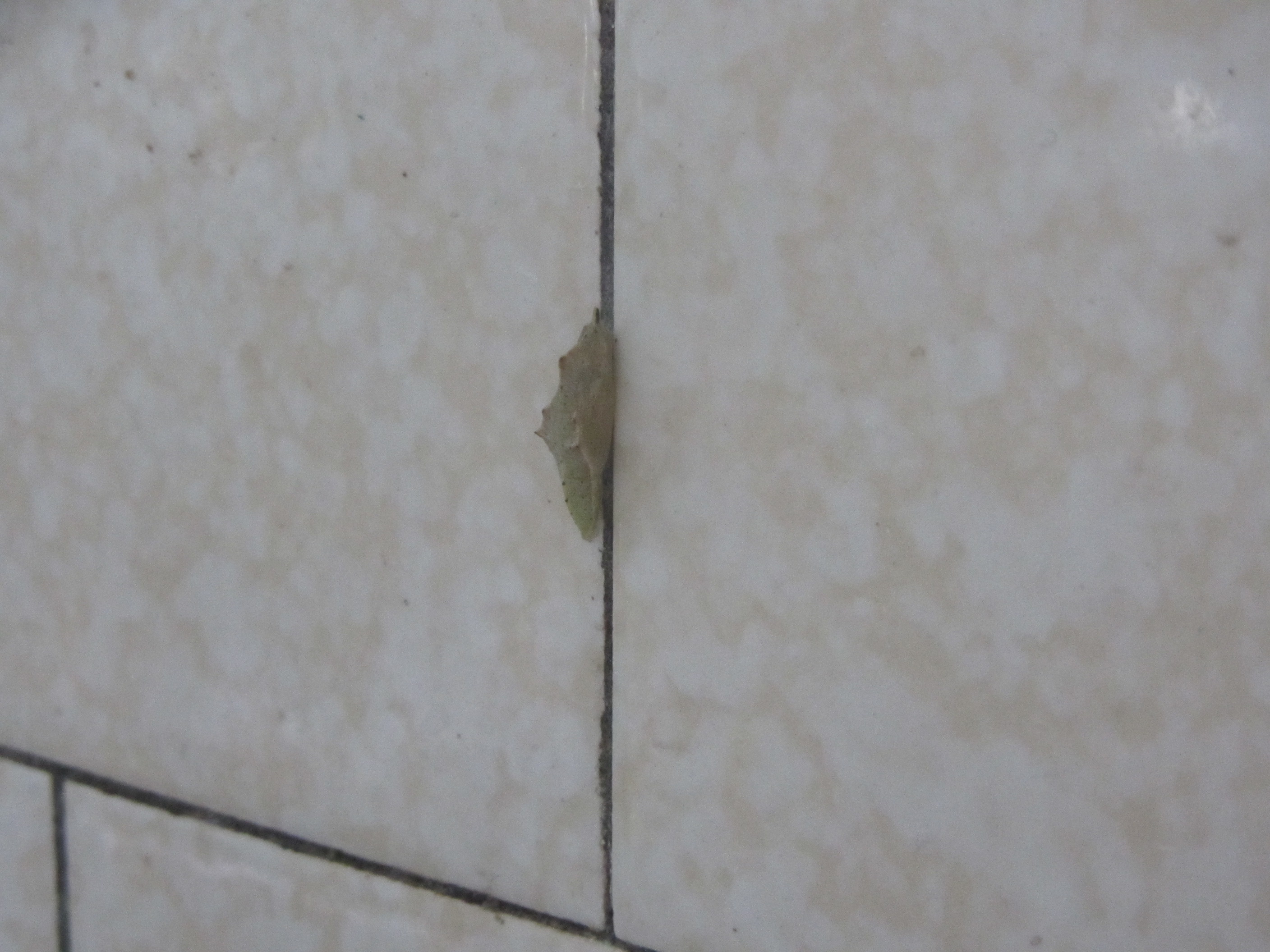
Cabbage butterfly pupa on the tile above my sink. A survivor from washing crucifers from the garden.

Cabbage butterfly pupa on the tile above my sink. A survivor from washing crucifers from the garden.

There are three primary reasons why I haven’t launched aggressive war on the cabbage butterfly (Pieris rapae) caterpillars munching on the cruciferous veggies in my garden, even though I don’t like them:  (1) garden neglect; (2) hostility towards most pesticides; and (3) bonhomie toward caterpillars by my toddler.  There is also a fourth reason.  I know that in general most plants increase production of chemical defense compounds when they detect that they’re being attacked by pathogens or herbivores (Textor and Gershenzon 2009).  Some of these defense compounds have been shown to be beneficial for human health, including those in crucifers.  I’ve been wondering for a while if those caterpillars were actually enhancing the value of the tissue they didn’t consume.  A recent report about a high-defense-compound laden variety of broccoli prompted me to do some research into the issue.  I’m left with more questions than answers. Continue reading

Aching for strawberries

If you have ever doubted the practical side of  plant anatomy, keep reading, as Katherine explains what you can learn about flowers by cutting up a strawberry.  As it turns out, this enigmatic little gem is packed with coincidences and apocrypha along with its citric acid and anthocyanins.  Could it turn out to be true that a strawberry is a berry after all?

Welcome to early June, when strawberry season is finally well underway across the US, as far north as the upper Midwest and New England.  Here in the promised land where little green plastic baskets are never empty (coastal northern California), there is still a peak season for strawberries, since the popular varieties don’t reach their full potential until mid-May.

With so many strawberries in so many kitchens this month, now is the perfect time to merge botany lab and breakfast preparation by working through the many parts of a strawberry.  Once you have mastered berry dissection, I promise you will find it a surprisingly versatile skill.  Having the confidence to steer a conversation towards strawberry anatomy can help you recover from one of the more awkward inevitabilities of summer – biting gracelessly through an enormous chocolate-covered strawberry just as you are introduced to the mother of the bride.  After you have pointed out the veins and ovaries and have explained the developmental origin of the epicalyx, she won’t remember the red juice and bits of chocolate shell you have just dribbled down your frontside.  Or so has been my experience. Continue reading