Category Archives: Uncategorized

Aching for strawberries

If you have ever doubted the practical side of  plant anatomy, keep reading, as Katherine explains what you can learn about flowers by cutting up a strawberry.  As it turns out, this enigmatic little gem is packed with coincidences and apocrypha along with its citric acid and anthocyanins.  Could it turn out to be true that a strawberry is a berry after all?

Welcome to early June, when strawberry season is finally well underway across the US, as far north as the upper Midwest and New England.  Here in the promised land where little green plastic baskets are never empty (coastal northern California), there is still a peak season for strawberries, since the popular varieties don’t reach their full potential until mid-May.

With so many strawberries in so many kitchens this month, now is the perfect time to merge botany lab and breakfast preparation by working through the many parts of a strawberry.  Once you have mastered berry dissection, I promise you will find it a surprisingly versatile skill.  Having the confidence to steer a conversation towards strawberry anatomy can help you recover from one of the more awkward inevitabilities of summer – biting gracelessly through an enormous chocolate-covered strawberry just as you are introduced to the mother of the bride.  After you have pointed out the veins and ovaries and have explained the developmental origin of the epicalyx, she won’t remember the red juice and bits of chocolate shell you have just dribbled down your frontside.  Or so has been my experience. Continue reading

Bamboo shoots: the facts about bracts, part 3

Bamboo shoots invade the lawn.  The biggest two are ready for harvest (photo by David Inouye)

Bamboo shoots invade the lawn. The biggest two are ready for harvest (photo by David Inouye)

Jeanne continues Bract Month here at the Botanist in the Kitchen by describing the morphology of an interesting and delicious springtime specialty:  fresh bamboo shoots.

I had the distinct pleasure a few weeks ago of trying a temperate springtime speciality:  fresh bamboo shoots.  The friend who shared them with me has a backyard bamboo thicket and harvests the young shoots when they pop up as incursions into the lawn.  Globally, he is in good company, as the fresh shoots show up in springtime (or otherwise seasonally appropriate) markets in most of Asia, which is the native range of most of the 1400+ bamboo species.  Probably like many modern Americans, before steaming the fresh shoots and putting them in a lovely spring chopped salad last week (we used a lemon-garlic-dill vinaigrette), I had only eaten bamboo shoots as neat, thin, rectangular or julienne slices of canned bamboo shoots in various Thai curries at and Chinese soups in restaurants.

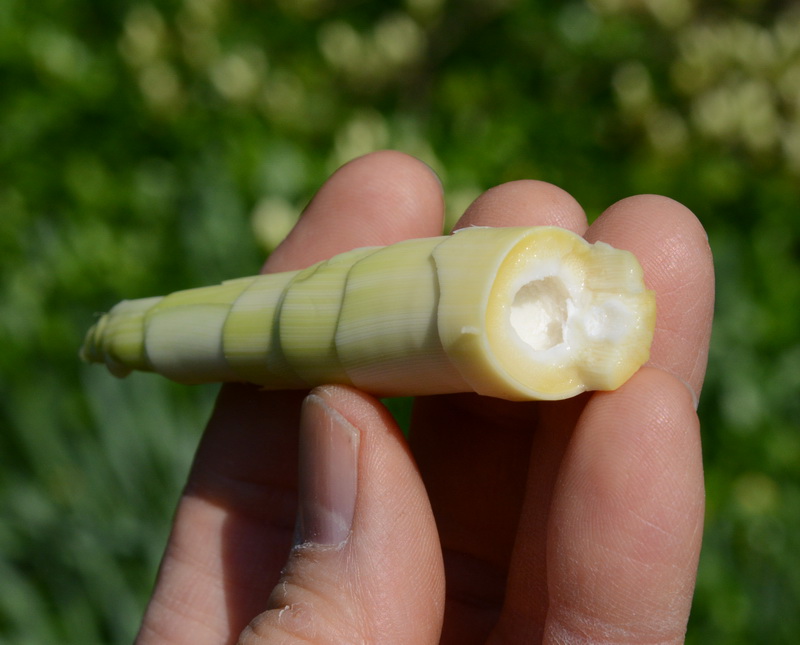
Peeled bamboo shoot, showing tender immature leaves and apical meristem tissue

Peeled bamboo shoot, showing tender immature leaves and apical meristem tissue (photo by David Inouye)

The fresh shoots are a big improvement over the canned and have the texture of asparagus and a flavor like a mild, tangy corn.  These similarities might arise from shared evolutionary history between bamboo and both vegetables.  Like corn, bamboo is a grass (family Poaceae; see our post on the evolution of gluten within the grasses for a phylogenetic context of bamboo within the grasses).  Like asparagus, bamboo is a perennial monocot (see our monocot diversity essay and our food plant tree of life for a refresher on monocots and their phylogenetic position within all plants), and its shoot is a new young stem developing from underground stems called rhizomes that spread out from a parent plant as a form of asexual reproduction. Continue reading

Preparing asparagus: the facts about bracts, part 2

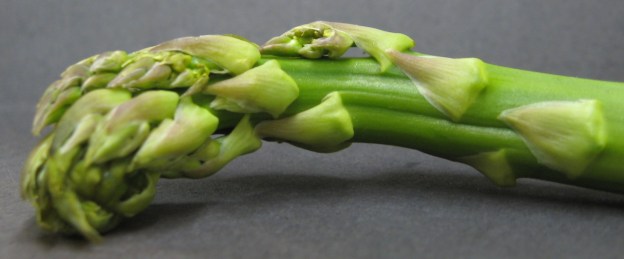
If artichokes are big balls of spiny bracts, then asparagus spears are telescoped rods with membranous scales.  In this follow up post, Katherine takes on asparagus, both the tender and the tough, and explains why peeling can’t rescue a woody spear.

Asparagus is a hopeful spring vegetable.  Asparagus aspires, breathes in the warming spring air, and optimistically pokes its nose up from the ground.  Its tips are clusters of tiny developing branches, still packed tightly like an unexpanded telescope, containing all the potential of a season’s worth of growth.  Except that we whack them and eat them  before they can realize their audacious plant dreams.  There’s no need to feel entirely bad about this, though.  The spears stay alive for a while, stubbornly growing tougher until they are cooked or digested. Continue reading

How to make an artichoke: the facts about bracts, part 1

Inspired by spring and the appearance of both artichokes and asparagus, Katherine explains artichoke morphology in the first of two posts about bracts and scales.

Artichokes don’t exactly look like food, and their name in English is homely and offputting.  The scientific name is no better.  Cynara cardunculus variety scolymus rolls off the tongue like a giant ball of tough spiny bracts.  I’m not ready to call it an onomatopoeia, even though artichokes are giant balls of tough spiny bracts.  And the word “bract,” on its own, is just flat-out ugly.  But artichoke bracts have delicious meaty bases, and they protect the tender inner part of the bud which we call the heart, so I am a C. cardunculus var. scolymus bract fan. Continue reading

Greens: why we eat the leaves that we do

Jeanne reveals which branches of the evolutionary tree of plants bear edible leaves and speculates about why that is.

Giant coconut palm (Cocos nucifera) fronds dwarf me

Giant coconut palm (Cocos nucifera) fronds dwarf me

Most of the 300,000 + plant species have leaves, and the function of all of them is to perform photosynthesis.  They are the ultimate source for all of the oxygen and food for the rest of the food chain and help regulate the global carbon and water cycles.  They are also nutrition superstars.  To figure out why greens are good for you and whether all leaves are equal in this regard, we need to take quick look at global leaf structural variability and broad evolutionary patterns in the species that make their way onto our tables. Continue reading

Cucurbita squash diversity

Jeanne introduces the diversity of some American natives, the squashes in the genus Cucurbita.

Spring is officially here, and I have squash on my mind.  We’ve ordered zucchini seeds for the upcoming summer garden but still have acorn squash from the fall sitting in the pantry (both are varieties of Cucurbita pepo). Our winter vegetable CSA box recently bequeathed to us the tastiest winter squash I’ve ever eaten, a Seminole pumpkin, which is a different variety of the same species (Cucurbita moschata) as the butternut squash sitting on the counter, destined for dinner.  Now between last year’s hard winter squashes and the tender summer squashes to come seems a good time to remind ourselves of the origins and diversity of squashes in the genus Cucurbita. Continue reading

Maple syrup mechanics: xylem, sap flow, and sugar content

It’s maple syrup making time in the Northeast.  Jeanne explains the mechanics of sap flow, collecting sap for syrup making, and why maples are special in this regard.  

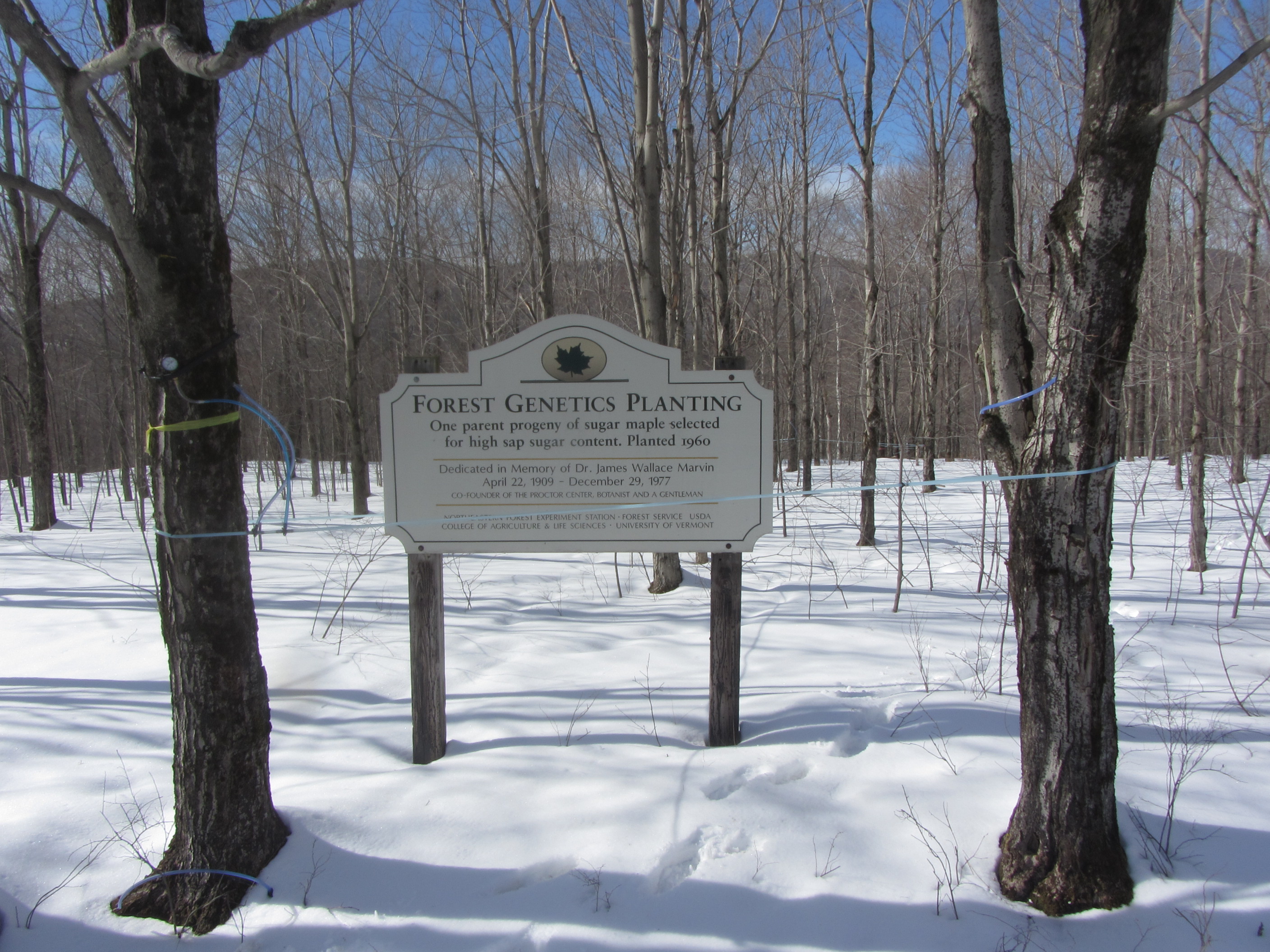
Proctor maple research field station, Underhill, VT

Proctor maple research field station, Underhill, VT

I had the great pleasure last weekend to visit the University of Vermont’s Proctor Maple Research Center in Underhill, VT, where the sugar maple (Acer saccharum, Sapindaceae) sap is flowing.  Sugar maple trees all around the northern hardwood forests in the Midwestern and Northeastern United States and southeastern Canada can now be “tapped,” fitted with a hollow tube in the sapwood, out of which sap flows and is collected and boiled down to maple syrup.

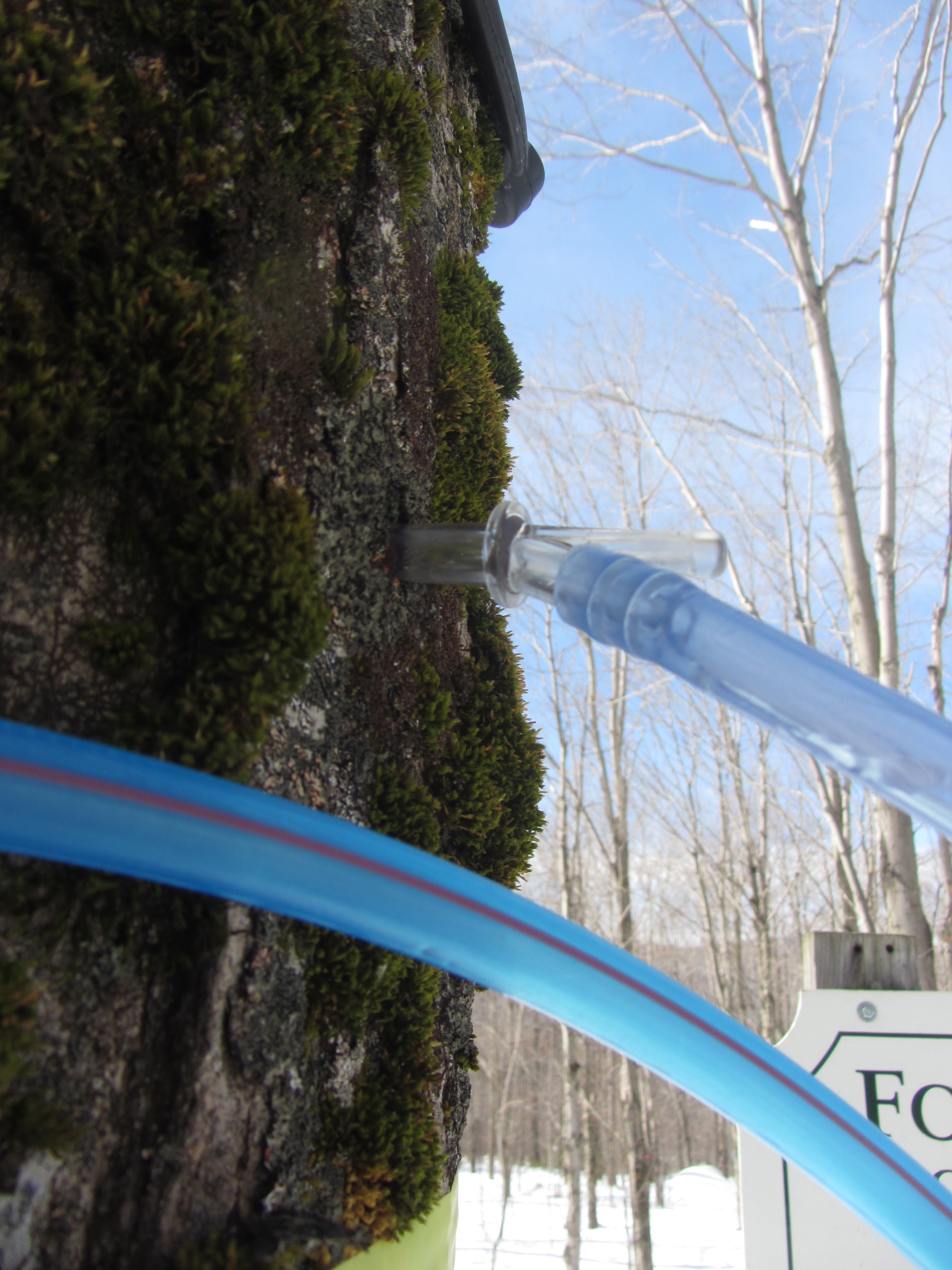
Tapping sugar maple to collect sap

Tapping sugar maple to collect sap, Proctor research station, Underhill, VT.

Maple syrup might be the oldest agricultural product in North America. Early 17th-century written records from Europeans exploring North America describe Native American use of sugar maple sap.  We of course can’t know how Native Americans discovered sugar maple sap, but it may have been by sampling a “sapsicle,” icicles made from frozen maple sap that forms at the end of a broken twig.  The evaporation of water during ice crystallization partially concentrates the sugar in the sap, making the sapsicle particularly sweet.  To understand how that sap got to the end of the twig in the dead of winter and why it’s so sweet, we need some basics about plant vasculature and carbohydrate storage and must figure out what makes maples so special. Continue reading

A very close look at potato leek soup

To understand how potatoes behave in the stock pot, Katherine puts a favorite soup under the microscope – literally.

Potato leek soup is the perfect soup. It is heaven pulled from the ground in all its humble grassy beauty. Potato leek soup is good-looking, simple, and flexible. It can be made vegan and provides nutrients and fiber with few calories. It is cheap, scales up for a crowd, and freezes well. Plus you have to love a soup with more names than ingredients. As a comforting wintertime staple, we call it what it is – potato leek soup. In tiny cups, sprinkled with chopped parsley and freshly ground black pepper, it becomes potage Parmentier, a rich tasting but delicate entrée to an elegant dinner party * . Chilled, with fresh cream, it is Vichyssoise, the cool, light partner of a good baguette and a glass of Pouilly-Fumé on the patio in summer. And my mother-in-law has demonstrated many times that when the holidays overwhelm your fridge, you can store a huge pot of potato leek soup on the porch overnight – as long as you put a brick on the lid to keep the raccoons out.

This amazing soup is the just about easiest thing in the world to make. Julia Child’s version is probably the most widely used, and the one I like: simmer equal parts cubed potato and sliced leek in water until they are tender. Add salt to taste and puree. A bit of cream is optional. A dusting of chopped parsley and freshly ground black pepper is divine. I like to err on the side of more potatoes than leeks, but the soup is robust to variations in proportion.

But is it really so easy? If you trust the internet more than you trust your favorite dog-eared chocolate-spattered cookbook with the broken spine and decades of marginalia (silly you), you may worry that without the right kind of potato and extremely careful handling, your soup will end up gluey. Is any wallpaper not pre-pasted these days? Doubtful, but everyone seems to describe gluey potato soup or mashed potatoes as “wallpaper paste.” I will say right up front that gluey soup has never happened to me, but given all the stress over this utterly simple soup, it seemed worth investigating. Continue reading

A look at leeks

FLUELLEN …and I do believe your majesty takes no scorn to wear the leek upon Saint Tavy’s day.
KING HENRY V I wear it for a memorable honour; For I am Welsh, you know, good countryman.
Shakespeare, Henry V, act 4, scene 7

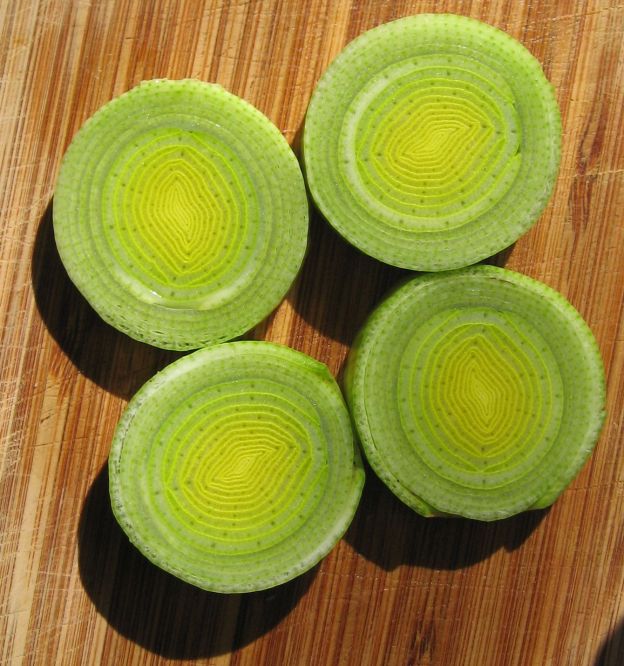
Break out the daffodils and leeks!  This past Friday, March 1, was St. David’s Day, the feast day of the patron saint of Wales and a national holiday in that country.  As long as you are cleaning and slicing leeks, let’s take a quick close look at the vegetable, one of the national symbols of Wales. Continue reading

Pomegranates and the art of herbivore attraction

Jeanne walks you through the botany you need to know to understand pomegranate fruit structure.  Jeanne’s definition of “need to know” is arguably a bit broad and includes a brief tour of the many different structures plants modify in order to entice herbivores, and at least one goddess, to disperse seeds. 

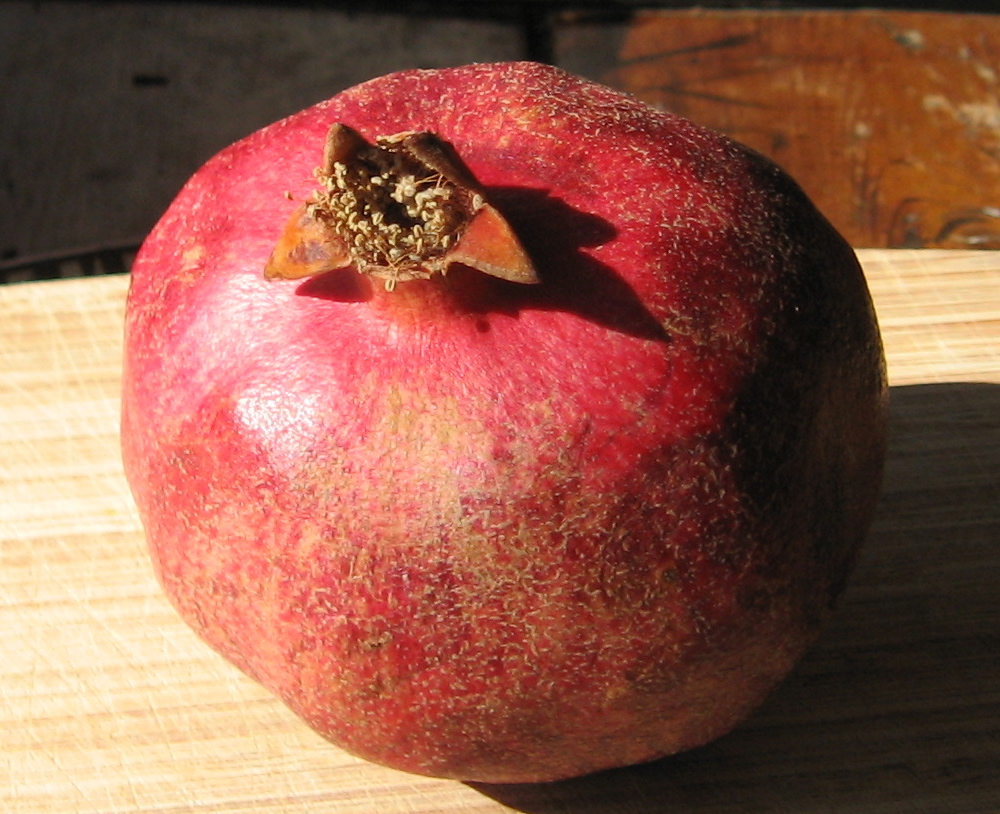
pomegranate fruit (persistent calyx and stamens visible)

pomegranate fruit (persistent calyx and stamens visible)

Pomegranates (Punica granatum, family Lythraceae, rosid order Myrtales) were one of the earliest domesticated plant species.  According to ancient Greek mythology, they even predate the seasons.  The story goes that Hades, god of the underworld, kidnapped his beloved Persephone, daughter of Demeter, goddess of the harvest.  Demeter’s grief over Persephone’s disappearance caused the crops to wither and wreaked havoc with humanity.  The plight of the starving masses coerced Zeus to convince Hades to return Persephone to her mother.  Before she left the underworld, however, Hades tricked her into eating a pomegranate seed, which bound her to evermore spend part of the year with her happy mother, during which time plants flourished, and part of the year in the underworld, during which time plants go fallow. Thus, seasons arose.

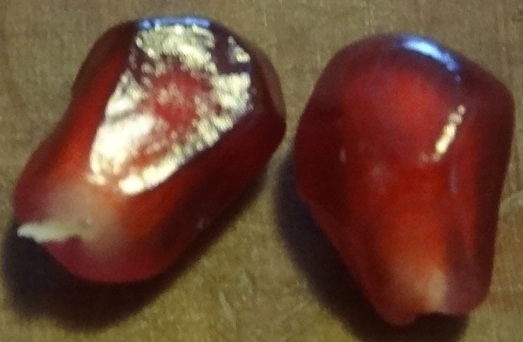
Pomegranate seeds

Pomegranate seeds

We can hardly blame poor Persephone for finding pomegranate seeds irresistible.  They look like faceted jewels and have a refreshing, tangy sweetness and a satisfying crunch. We have an additional reason to be drawn to pomegranates: even if they can’t help us understand the seasons, deciphering the structures of the beautiful pomegranate fruit helps us understand the diversity of mechanisms plants use to entice animals, including humans, to disperse seeds.  The delicious, nutritious or fibrous attractive structure is payment for the animal’s labor. As you will see in this post, there is no single anatomical recipe for creating the colorful, fleshy and/or juicy reward for a seed-dispersing herbivore, mortal or otherwise.  Many of the myriad flower, fruit and seed structures are variously promoted to the role of what is colloquially thought of as “fruit.” Continue reading