Triple threat watermelon

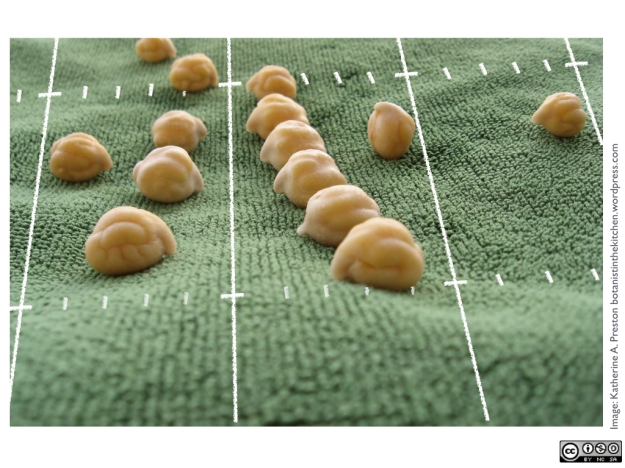
Will seedless watermelons make us superhuman or turn our children into giants?  Hardly, but they do give home cooks the power to count chromosomes without a microscope.   Just a knife or a hard thunk on the sidewalk are enough to get a watermelon to spill its genetic guts.

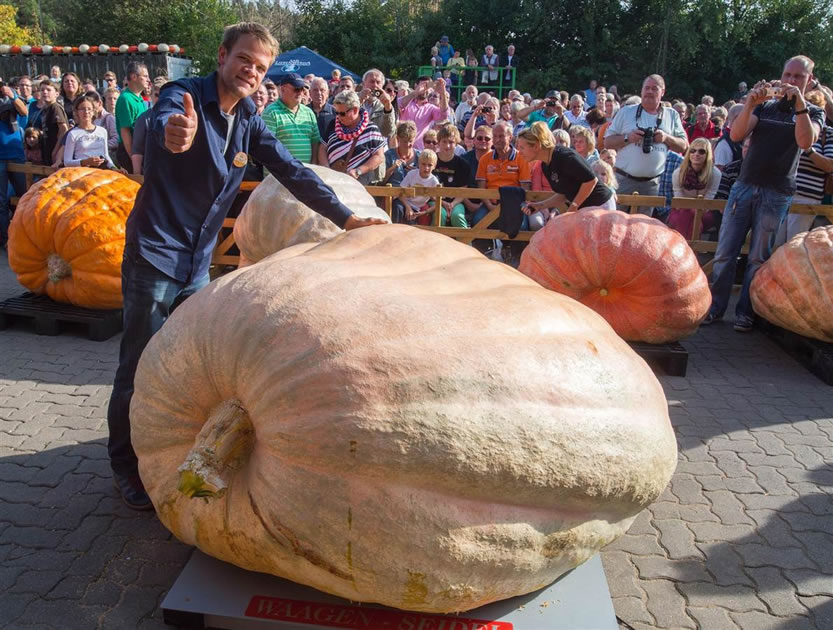
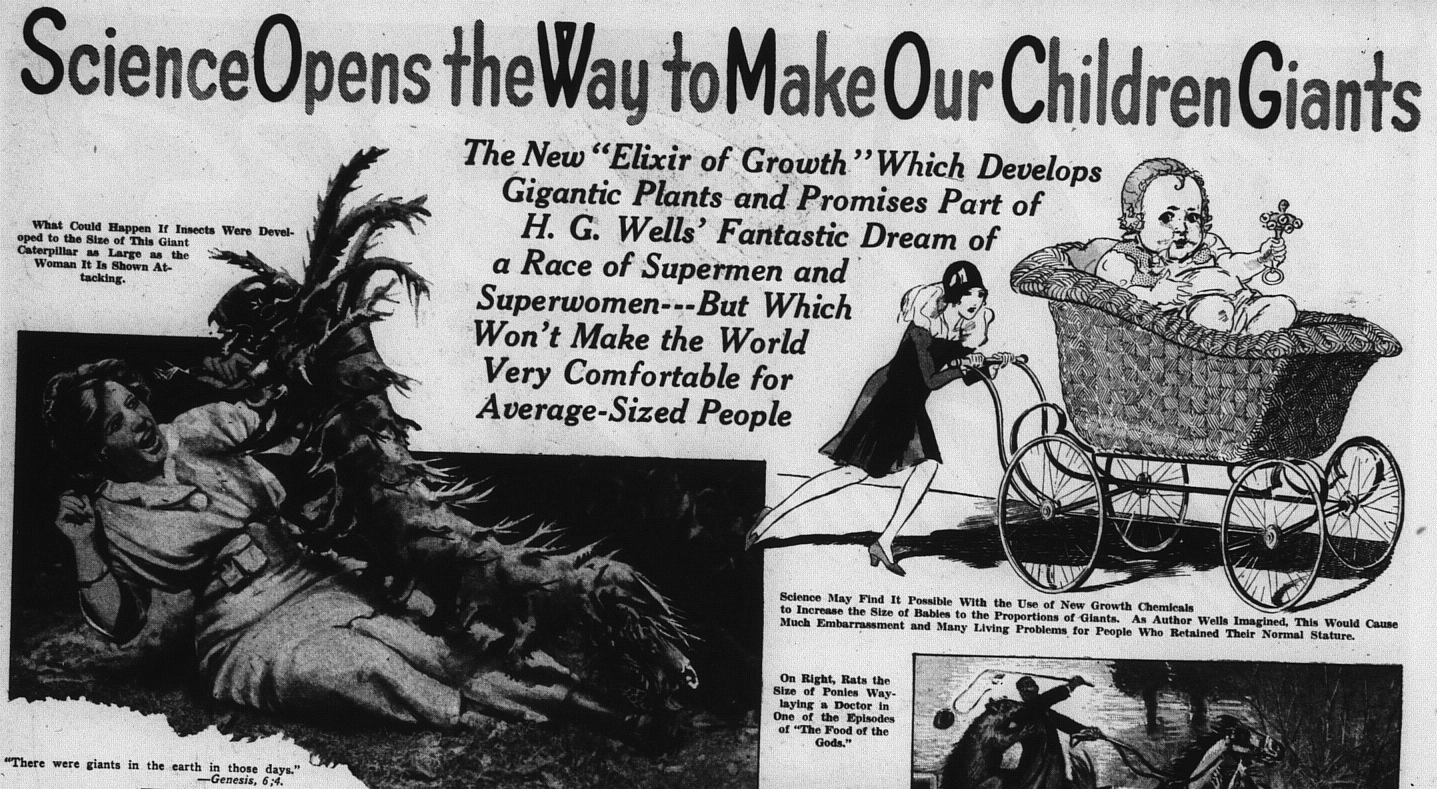
If you were reading a Hearst Corporation newspaper in late 1937, you might have thought humanity would eventually be swallowed up by giant carnivorous plants, unwittingly unleashed by uncontrolled biotechnology.  The San Francisco Examiner reported on November 21st of that year that the discovery of an “elixir of growth,” meant that “…science may at last have a grip on the steering wheel of evolution, and be able to produce at will almost any kind of species…”  including “…a plague of man-eating ones.”  In 1937 Americans had much more important things to worry about, just as we do now.  Still, that discovery may in fact have threatened one cherished aspect of the American way of life by triggering the slow demise of late summer state fair watermelon seed spitting contests.  It doubtlessly paved the way for seedless watermelons, and in 2014 the total harvest of seedless watermelons on American farms – nearly 700 thousand tons – outweighed the seeded watermelon harvest more than 13 to 1 (USDA National Watermelon Report). A similar pattern is emerging this year.  Is there no stopping the attack of the seedless watermelons?

Image from microfilm of an actual page in the San Francisco Examiner, published Sunday November 21, 1937. Found in the Media and Microtext Center of Stanford University Libraries.

CLICK to read. Image from microfilm of an actual page in the San Francisco Examiner, published Sunday November 21, 1937. Found in the Media and Microtext Center of Stanford University Libraries.

And more important, how is it even possible to get seedless fruit from an annual plant?  From a plant whose only mode of reproduction is through those very seeds?  From a plant that cannot make suckers as bananas do and cannot be perpetuated endlessly through grafts like fruit trees and vines?   Such is the challenge posed every single year by watermelons, but thanks to the “elixir of growth” discovered by Albert Blakeslee and subsequent work by Hitoshi Kihara, one of the most prominent agricultural geneticists of the 20th century, the world has an elegant solution. Breeders continually improve the varieties available, and consumer demand keeps growing, yet seedless watermelon production methods have remained essentially unchanged for three quarters of a century. Continue reading

The new apples: an explosion of crisp pink honey sweet snow white candy crunch

What’s in a name?  An apple with an old fashioned name could taste as sweet, but it might not sell.  The most sought after branded varieties reveal what people look for in an apple: sweet and crunchy and bright white inside.  Do the fruits live up to their names?  Are Honeycrisp apples crunchier than others?  Do Arctics actually stay white?  We zoom in on the cells to find out.

Some of you will remember the era when the Superbowl halftime show repeatedly featured Up With People.  That was around the time when Granny Smiths arrived in our supermarkets and finally gave Americans a third apple, a tart and crunchy alternative to red and golden delicious.  Those were simple days.  Continue reading

Taking advantage of convergent terpene evolution in the kitchen

The Cooks Illustrated recipe masters recently added nutmeg and orange zest to a pepper-crusted steak to replace two flavorful terpenes, pinene and limonene, lost from black pepper when simmered in oil. In doing so they take advantage of convergent evolution of terpenoids, the most diverse group of chemical products produced by plants. Nutmeg and orange zest, though, were hardly their only options.

The terpene swap

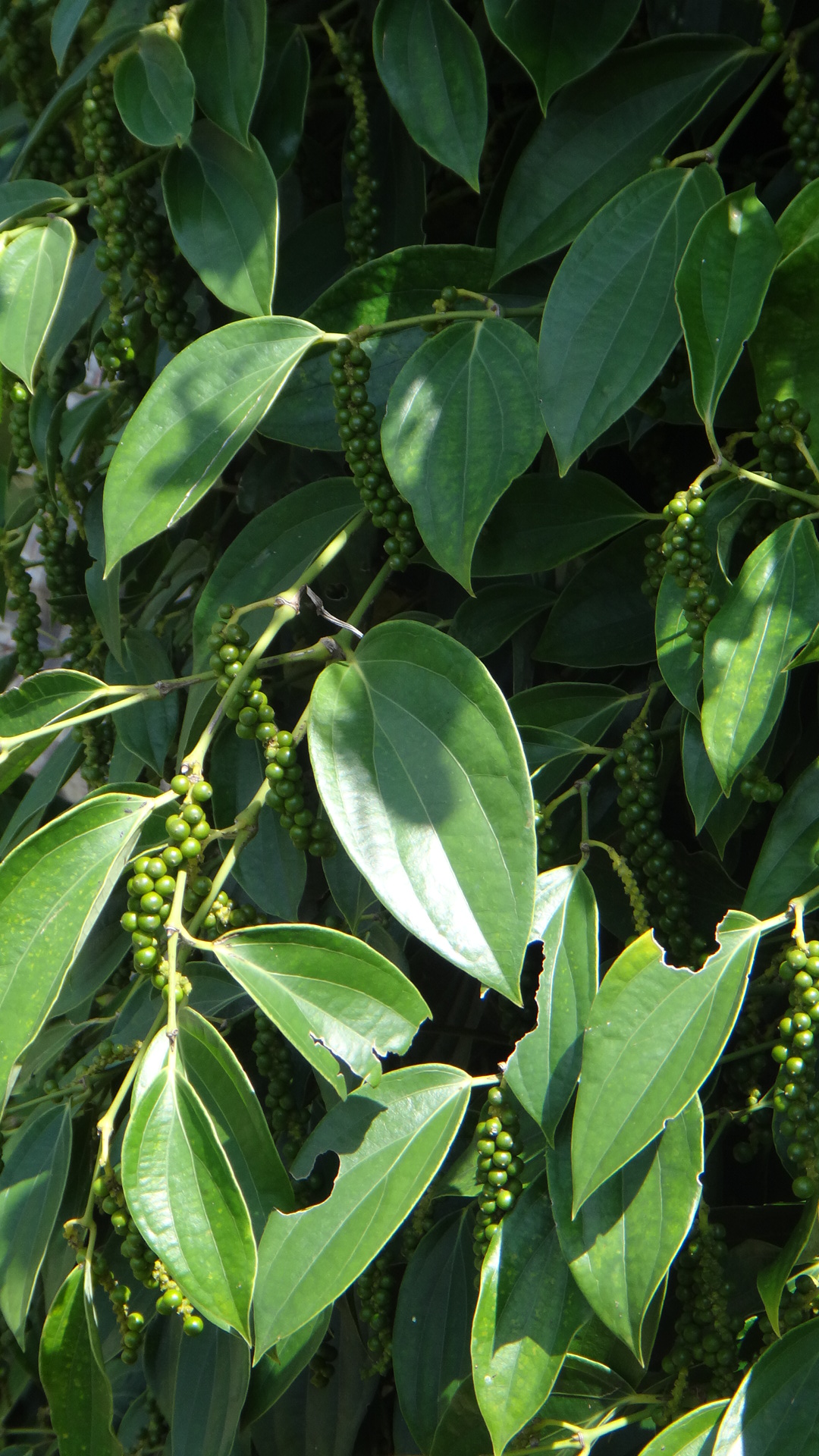
Black pepper (Piper nigrum) growing in Cambodia (photo by L. Osnas)

Black pepper growing (photo by L. Osnas)

To develop satisfying crunch, the Cooks Illustrated recipe for pepper-crusted beef tenderloin requires a prodigious quantity of coarsely ground black pepper (Piper nigrum; family Piperaceae). If applied to the meat raw, however, in the recipe authors’ view, this heap of pepper generates an unwelcome amount of spicy heat. To mellow it, the recipe authors recommend simmering the pepper in oil and straining it out of the oil before adding it to the dry rub. The hot oil draws out the alkaloid piperine, which makes black pepper taste hot, from the cracked black pepper fruits (peppercorns).

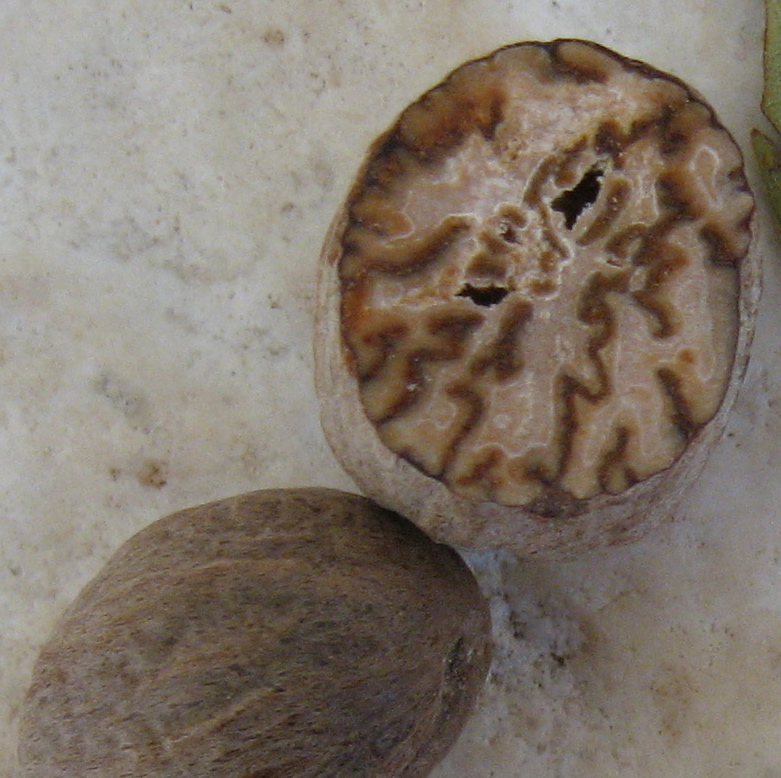
Nutmeg seed showing brown seed coat folded within the ruminate endosperm

Nutmeg seed

To their dismay, however, the recipe authors discovered that the hot oil also removes flavorful compounds from the cracked pepper, in particular the terpenes pinene and limonene. To rectify this flavor problem, the recipe authors added pinene-rich nutmeg (Myristica fragrans; Myristicaceae) and limonene-rich orange (Citrus x sinensis; Rutaceae) zest to the dry rub, along with the simmered black pepper. In doing so they take advantage of widespread and diverse array of terpenoids in the plant kingdom. Continue reading

Rapunzel

220px-0_Campanula_rapunculus_-_Yvoire

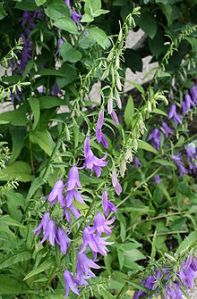
A close relative of The rapunzel plant (Campanula rapunuloides). Photo from Wikipedia.

I never suspected that I’d learn something about edible botany by indulging my 3-year-old’s princess obsession, but I have. According to the Brothers Grimm, Princess Rapunzel is named after the cultivated  vegetable of the same name, growing in a witch’s garden. The wording of the story suggested to me that the Grimms’ contemporaries would be familiar with the plant as a vegetable, that it wasn’t a fantastical invented thing. Apparently rapunzel was a popular vegetable in the Grimm’s Europe.

Formally the rapunzel plant is Campanula rapunculus, native from southwestern Asia through central Europe to North Africa. The genus Campanula contains upwards of 500 species of what are commonly called bluebells, bellflowers, or harebells, widely distributed throughout the northern hemisphere. Many if not most of those species have edible flowers, leaves and roots (see links herehere, here and here). The Brothers Grimm don’t specify which parts of the plant were particularly enticing to Princess Rapunzel’s mother.

Our princess, in the Tangled-inspired dress from Santa

Our princess, in the Tangled-inspired dress from Santa

Many species in the closesly-related genus Adenophora also have edible roots, leaves and flowers. These genera add a taxonomic family, Campanulaceae, to our list of taxa with culinary species. Campanulaceae joins the sunflower family (Asteraceae) as culinary families in the order Asterales. Rapunzel seeds are for sale, and it can grow in Anchorage, where we will be moving this spring. My little Rapunzel will have to beat the moose to it in the garden next summer. It’s so interesting to me that this was once considered a common, mainstream cultivated vegetable, but now it’s considered a fringe edible plant or something to be “wildharvested.” It’s fun to learn about plants that were once widely cultivated for food but have since fallen out of fashion. Wonder why that is.

Apples: the ultimate everyday accessory

Infinity scarves? No. They won’t keep doctors away. Apples are the ultimate everyday accessory (fruit). Katherine explains where the star in the apple comes from. Could it be due to a random doubling of chromosomes? We also give readers the chance to test their apple knowledge with a video quiz.

Although apples are not particularly American – nor is apple pie – they color our landscape from New York City to Washington State, all thanks to Johnny Appleseed. Or so goes the legend. Everyone already knows a lot about apples, and for those wanting more, there are many engaging and beautifully written stories of their cultural history, diversity, and uses. See the reference list below for some good ones. There is no way I could cover the same ground, so instead I’ll keep this post short and sweet (or crisp and tart) by focusing on apple fruit structure and some interesting new studies that shed light on it.
Of course if you do want to learn more about apple history but have only 5 minutes, or if you want to test your current knowledge, take our video quiz! It’s at the bottom of this page. Continue reading

Alliums, Brimstone Tart, and the raison d’etre of spices

If it smells like onion or garlic, it’s in the genus Allium, and it smells that way because of an ancient arms raceThose alliaceous aromas have a lot of sulfur in them, like their counterparts in the crucifers. You can combine them into a Brimstone Tart, if you can get past the tears.

The alliums

DSC09511

garlic curing

The genus Allium is one of the largest genera on the planet, boasting (probably) over 800 species (Friesen et al. 2006, Hirschegger et al. 2009, Mashayehki and Columbus 2014), with most species clustered around central Asia or western North America. Like all of the very speciose genera, Allium includes tremendous variation and internal evolutionary diversification within the genus, and 15 monophyletic (derived from a single common ancestor) subgenera within Allium are currently recognized (Friesen et al. 2006). Only a few have commonly cultivated (or wildharvested by me) species, however, shown on the phylogeny below. Continue reading

The Extreme Monocots

Coconut palms grow some of the biggest seeds on the planet (coconuts), and the tiny black specks in very good real vanilla ice cream are clumps of some of the smallest, seeds from the fruit of the vanilla orchid (the vanilla “bean”). Both palms and orchids are in the large clade of plants called monocots. About a sixth of flowering plant species are monocots, and among them are several noteworthy botanical record-holders and important food plants, all subject to biological factors pushing the size of their seeds to the extremes. Continue reading

Walnut nostalgia

Walnuts may not seem like summer fruits, but they are – as long as you have the right recipe.  Katherine takes you to the heart of French walnut country for green walnut season.

France 1154 Eng newAnnotation fullRes 2

Public domain, via wikimedia commons

English walnuts do not come from England. The English walnut came to American shores from England, but the English got them from the French. The (now) French adopted walnut cultivation from the Romans two millennia ago, back when they were still citizens of Gallia Aquitania. Some people call this common walnut species “Persian walnut,” a slightly better name, as it does seem to have evolved originally somewhere east of the Mediterranean. But the most accurate name for the common walnut is Juglans regia, which means something like “Jove’s kingly nuts.” I think of them as queenly nuts, in honor of Eleanor of Aquitaine, because if any queen had nuts, she certainly did. During her lifetime the Aquitaine region of France became a major exporter of walnuts and walnut oil to northern Europe, and it remains so more than 800 years later. Continue reading

An apple for the teacher

With her fellow educators in mind, Katherine tells a story of virtual botany in the dining hall and letting students be teachers.

When we botanists in the kitchen are quiet for a little while, it usually means we are focusing all of our attention on our day jobs.  Like a garden, the academic calendar has a rhythm that cannot be ignored, and from April through June, I pour most of my time and creative energy into my small seminar class, where we dig into the evolutionary and ecological connections between humans and plants across many time scales and topics. It’s a fun class and the debate is usually lively, but because the journal articles we discuss are often dense and technical, I sometimes worry that we are squelching some opportunities for joy. Continue reading

A biologist eating for two

This is a bit tangential to our usual fare, but I think it’s fun, and you may as well. A friend of mine, Cara Bertron, edits the creative and delightful quarterly compendium Pocket Guide. I submitted this image, entitled “A biologist eating for two,” for the current issue, which is themed “secret recipes.” It’s a cladogram of the phylogenetic relationships among all the (multicellular) organisms I (knowingly) ate when I was pregnant with my now two-year-old daughter. Continue reading