Tag Archives: recipe

Okra – what’s not to like?

What is hairy, green, full of slime, and delicious covered in chocolate? It has to be okra, bhindi, gumbo, Abelmoschus esculentus, the edible parent of musk. Katherine explores okra structure, its kinship with chocolate, and especially its slippery nature. What’s not to like?
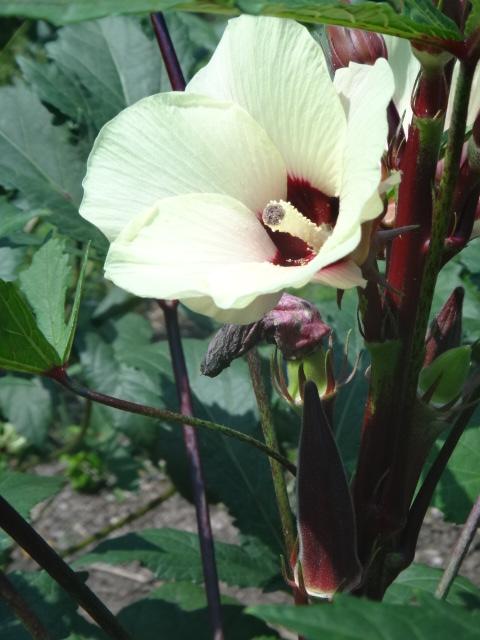
Okra flower with red fruit below

Okra flower with red fruit below

People often ask me about okra slime. Rarely do they ask for a good chocolate and okra recipe, which I will share unbidden. With or without the chocolate, though, okra is a tasty vegetable. The fruits can be fried, pickled, roasted, sautéed, and stewed. Young leaves are also edible, although I have never tried them and have no recipes. Okra fruits are low in calories and glycemic index and high in vitamin C, fiber, and minerals. The plant grows vigorously and quickly in hot climates, producing large and lovely cream colored flowers with red centers and imbricate petals. The bright green or rich burgundy young fruits are covered in soft hairs. When they are sliced raw, they look like intricate lace doilies. In stews, the slices look coarser, like wagon wheels. And yes, okra is slimy. And it is in the mallow family (Malvaceae), along with cotton, hibiscus, durian fruit, and chocolate. Continue reading
Making ratatouille like a botanist

The story of the nightshades is usually told as a tale of European explorers, New World agriculturalists, and a wary bunch of Old World eaters.  But what about the birds?  And the goji berries?  Jeanne and Katherine introduce you to the Solanaceae family and walk you through the botany to be observed while making ratatouille, the classic French collision of Eastern and Western nightshades.

Can you imagine Italian cuisine without tomatoes? The Irish without potatoes? Chinese cuisine without spicy, fruity chiles?  Such was the case prior to the discovery of the New World nightshades (family Solanaceae) by sixteenth-century Spanish explorers.  And they couldn’t help but run into them.  Solanaceae is a huge family, with over 100 genera and nearly 2500 species, most of which are in Central and South America. Continue reading

Caterpillars on my crucifers: friends or foes?

A high glucosinolate (putatively anti-cancer) broccoli variety is now on the market.  Jeanne wonders if caterpillar herbivory-induced increases in glucosinolates can match it.  The answer is unsatisfyingly complicated. 

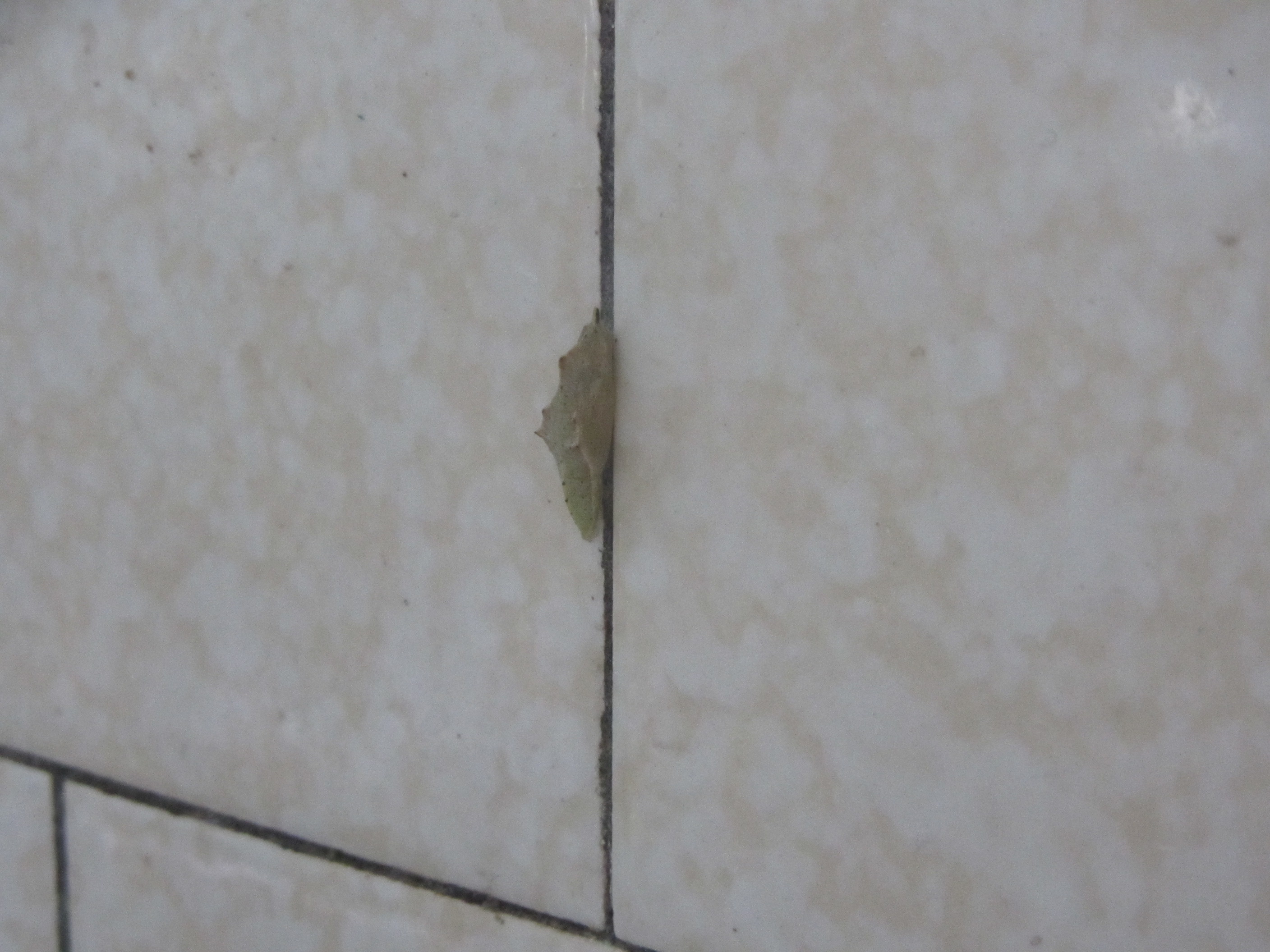
Cabbage butterfly pupa on the tile above my sink. A survivor from washing crucifers from the garden.

Cabbage butterfly pupa on the tile above my sink. A survivor from washing crucifers from the garden.

There are three primary reasons why I haven’t launched aggressive war on the cabbage butterfly (Pieris rapae) caterpillars munching on the cruciferous veggies in my garden, even though I don’t like them:  (1) garden neglect; (2) hostility towards most pesticides; and (3) bonhomie toward caterpillars by my toddler.  There is also a fourth reason.  I know that in general most plants increase production of chemical defense compounds when they detect that they’re being attacked by pathogens or herbivores (Textor and Gershenzon 2009).  Some of these defense compounds have been shown to be beneficial for human health, including those in crucifers.  I’ve been wondering for a while if those caterpillars were actually enhancing the value of the tissue they didn’t consume.  A recent report about a high-defense-compound laden variety of broccoli prompted me to do some research into the issue.  I’m left with more questions than answers. Continue reading

How to make an artichoke: the facts about bracts, part 1

Inspired by spring and the appearance of both artichokes and asparagus, Katherine explains artichoke morphology in the first of two posts about bracts and scales.

Artichokes don’t exactly look like food, and their name in English is homely and offputting.  The scientific name is no better.  Cynara cardunculus variety scolymus rolls off the tongue like a giant ball of tough spiny bracts.  I’m not ready to call it an onomatopoeia, even though artichokes are giant balls of tough spiny bracts.  And the word “bract,” on its own, is just flat-out ugly.  But artichoke bracts have delicious meaty bases, and they protect the tender inner part of the bud which we call the heart, so I am a C. cardunculus var. scolymus bract fan. Continue reading

A very close look at potato leek soup

To understand how potatoes behave in the stock pot, Katherine puts a favorite soup under the microscope – literally.

Potato leek soup is the perfect soup. It is heaven pulled from the ground in all its humble grassy beauty. Potato leek soup is good-looking, simple, and flexible. It can be made vegan and provides nutrients and fiber with few calories. It is cheap, scales up for a crowd, and freezes well. Plus you have to love a soup with more names than ingredients. As a comforting wintertime staple, we call it what it is – potato leek soup. In tiny cups, sprinkled with chopped parsley and freshly ground black pepper, it becomes potage Parmentier, a rich tasting but delicate entrée to an elegant dinner party * . Chilled, with fresh cream, it is Vichyssoise, the cool, light partner of a good baguette and a glass of Pouilly-Fumé on the patio in summer. And my mother-in-law has demonstrated many times that when the holidays overwhelm your fridge, you can store a huge pot of potato leek soup on the porch overnight – as long as you put a brick on the lid to keep the raccoons out.

This amazing soup is the just about easiest thing in the world to make. Julia Child’s version is probably the most widely used, and the one I like: simmer equal parts cubed potato and sliced leek in water until they are tender. Add salt to taste and puree. A bit of cream is optional. A dusting of chopped parsley and freshly ground black pepper is divine. I like to err on the side of more potatoes than leeks, but the soup is robust to variations in proportion.

But is it really so easy? If you trust the internet more than you trust your favorite dog-eared chocolate-spattered cookbook with the broken spine and decades of marginalia (silly you), you may worry that without the right kind of potato and extremely careful handling, your soup will end up gluey. Is any wallpaper not pre-pasted these days? Doubtful, but everyone seems to describe gluey potato soup or mashed potatoes as “wallpaper paste.” I will say right up front that gluey soup has never happened to me, but given all the stress over this utterly simple soup, it seemed worth investigating. Continue reading

Welcome to 2013, the International Year of Quinoa

Can we call quinoa a grain? Why do people care?  Where did all these geese feet come from, and what does Ban Ki-moon have to do with it?  On long winter runs, Katherine’s mind wanders over such questions.

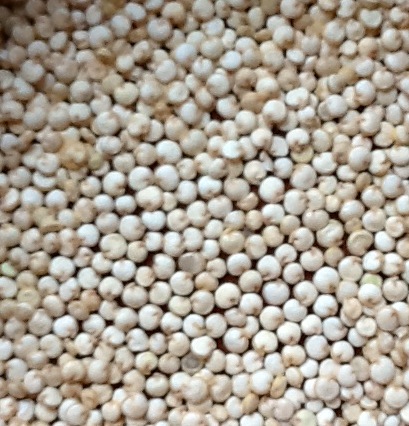
Quinoa seeds (Chenopodium quinoa)

Quinoa seeds (Chenopodium quinoa)

In the final two months of 2012, questions about quinoa and its status as a “grain” came up three separate times within my earshot.  This was odd in itself, but it launched a cascade of coincidences.  On a run near the baylands, my mind was idling back over those conversations, when I noticed for the first time a little weed along the trail, looking much like one of quinoa’s relatives, a saltbush.  (The crushed specimen I carried home in my shoe laces keyed out as Atriplex semibaccata, Australian saltbush.)  There is also a gorgeous and much larger saltbush species along the trail, and yet another relative, an edible Salicornia species (“sea beans”) that fills the marshy areas next to the bay.  Along with quinoa, spinach, beets, and chard, all of these species belong to the (former) goosefoot family – the Chenopodiaceae – which is now considered a branch nested within the Amaranth family.  Quinoa is a central member of this old family, belonging in the namesake genus Chenopodium. Continue reading

A brief history of gluten

Victory with creating a gluten-free quick bread recipe inspires Jeanne to give you a brief primer on the evolutionary history of gluten within the grass family. 

We were perhaps a little too enthusiastic this fall in our apple picking at a local orchard and our acquisition of interesting squash at our farmer’s markets.  Our freezer now contains many bags of applesauce and squash puree.  We must now “do something,” as we say, with all of it, meaning use the purees as ingredients.  Lately I’ve been working on incorporating the purees into nutritious (low sugar, high protein, whole grain) quick breads.  On my doctor’s recommendation, that quick bread also needs to be gluten-free.  Increasing appearances of the phrase “gluten free” on restaurant menus and product labels are noble efforts to accommodate the needs of people who have celiac disease or other dietary sensitivities to gluten.  Baking without gluten is a challenge, as gluten is what gives wheat dough its elasticity and allows yeasted wheat bread to rise.  The internet makes gluten-free baking more accessible by the day, but I haven’t yet found someone else’s recipe that really does what I want, so I’ve been working on my own.  I’m fairly pleased with the latest result (below) and thought I would use the occasion to give you a brief evolutionary history of gluten and the botanical family that makes it:  the grasses. Continue reading

Varieties of the pepper experience

Chili, black pepper, white pepper, and Sichuan pepper

Black pepper, pink peppercorns, chili pepper, Sichuan pepper – except for being “hot,” these spices have as little in common as Sergeant Pepper and Pepper Potts.  Their homelands are scattered across the world, and they were spread through distinct trade routes.  They are not closely related; they belong to families about as far apart as possible on the phylogenetic tree below.  They even aim their heat at different sensory receptors in your mouth. Continue reading

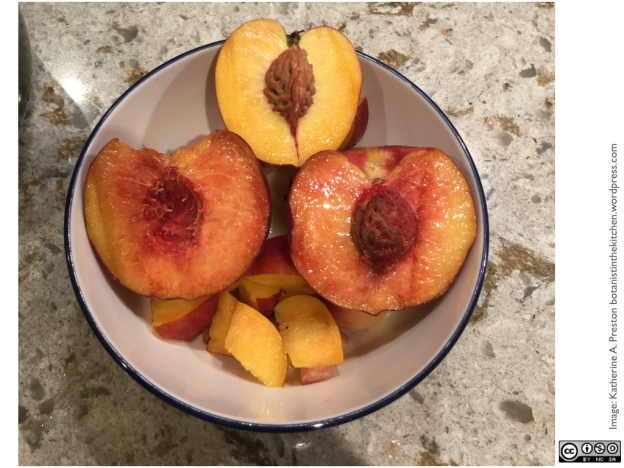
Yellow freestone peaches, one with a bit of anthocyanin in its flesh

The Stone fruits of summer

The scent of ripening peaches spurs Katherine’s musings on the botany
of stone fruits

Fragrant peaches ripening on window sills and countertops pull me right back into the heart of my childhood summers.  They always arrived in a huge box from Georgia, sent by my grandmother in the hope of drawing my parents back to their native state. Her other lures included Vidalia onions in April and Claxton fruitcakes in November, but peaches were definitely her best shot. The peaches were gorgeous, and their ripe flavor was incredibly complex and vivid, but their peak was ephemeral.  After my sister and I had spread them all out on newspapers, the whole sprawling array had to be checked at least two times a day and sorted by ripeness. Peaches were never allowed to touch each other.  On some hot days, peach tending took on the urgency of triage, with fruits passing from ripe to “sharp” to downright alcoholic in one long afternoon.

Peaches, nectarines, plums, apricots, and cherries are sometimes called stone fruits because of their pits, or stones.  Along with almonds, they are all in the genus Prunus which belongs to the Rose family – Rosaceae.  Several other familiar fruits come from the rose family but are not stone fruits. Continue reading