Author Archives: katherineapreston

Unknown's avatar

About katherineapreston

I never get tired of looking at plants. My scientific research is in the area of plant physiological ecology, specifically the way plant form constrains or influences plant function. Throughout my career, I have had the pleasure of teaching introductory botany many times, and I love to see what happens when people start to look at plants closely, with patience, attention, and curiosity.

Of sweet potatoes and putting down roots

On a hunt for a traditional Thanksgiving tuber, Katherine discovers what it takes to root your own sweet potatoes.  Here she explains how sweet potatoes are put together, which anyone can observe in the kitchen.

The Sunday before Thanksgiving – the first Thanksgiving in 19 years that I have not spent with my family in Georgia – I was on a hunt for sweet potatoes.  Not a single one of my favorite vendors at the Mountain View farmers market grew them this year.  Finally, I questioned Luis Miranda of Wholeness Farms, who has always given me clear and patient explanations of many aspects of farming.  In his charming Nicaraguan accent, he simply said that sweet potatoes are a “long crop.”

Sweet potatoes of all kinds – orange, white, or purple, garnets, Beauregards, Georgia jets, and white stars – are members of the species Ipomoea batatas, in the morning glory family, Convolvulaceae. Continue reading

Varieties of the pepper experience

Chili, black pepper, white pepper, and Sichuan pepper

Black pepper, pink peppercorns, chili pepper, Sichuan pepper – except for being “hot,” these spices have as little in common as Sergeant Pepper and Pepper Potts.  Their homelands are scattered across the world, and they were spread through distinct trade routes.  They are not closely related; they belong to families about as far apart as possible on the phylogenetic tree below.  They even aim their heat at different sensory receptors in your mouth. Continue reading

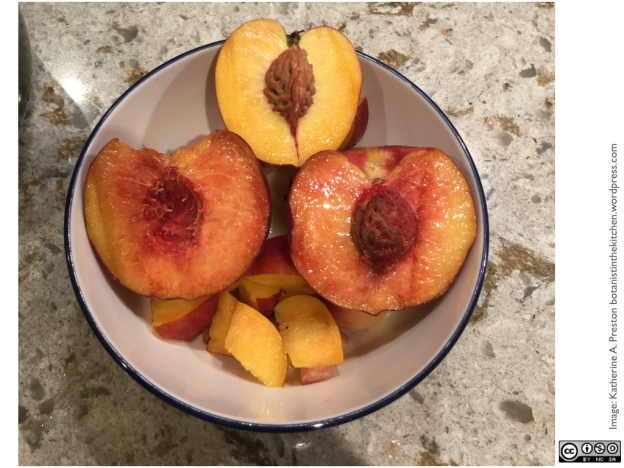
Yellow freestone peaches, one with a bit of anthocyanin in its flesh

The Stone fruits of summer

The scent of ripening peaches spurs Katherine’s musings on the botany
of stone fruits

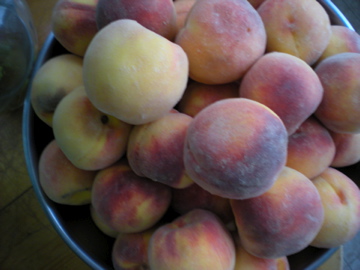
Fragrant peaches ripening on window sills and countertops pull me right back into the heart of my childhood summers.  They always arrived in a huge box from Georgia, sent by my grandmother in the hope of drawing my parents back to their native state. Her other lures included Vidalia onions in April and Claxton fruitcakes in November, but peaches were definitely her best shot. The peaches were gorgeous, and their ripe flavor was incredibly complex and vivid, but their peak was ephemeral.  After my sister and I had spread them all out on newspapers, the whole sprawling array had to be checked at least two times a day and sorted by ripeness. Peaches were never allowed to touch each other.  On some hot days, peach tending took on the urgency of triage, with fruits passing from ripe to “sharp” to downright alcoholic in one long afternoon.

Peaches, nectarines, plums, apricots, and cherries are sometimes called stone fruits because of their pits, or stones.  Along with almonds, they are all in the genus Prunus which belongs to the Rose family – Rosaceae.  Several other familiar fruits come from the rose family but are not stone fruits. Continue reading

Do peaches belong in the fridge?

Some people just cannot bring themselves to refrigerate peaches. Storing peaches lovingly at room temperature is said to coax out the best in peach scent, flavor, and texture. But treating peaches this way does take a lot of time and vigilance, as I detail elsewhere. Reliable authorities – peach packing houses and state extension agencies – recommend refrigerating peaches once they become ripe, but some people would rather risk losing fruit to rot than let them get cold. But does it matter? Can peaches be stored in the fridge to slow their decline without compromising their peak? Continue reading