Let’s get it started with some black-eyed peas (and rice)

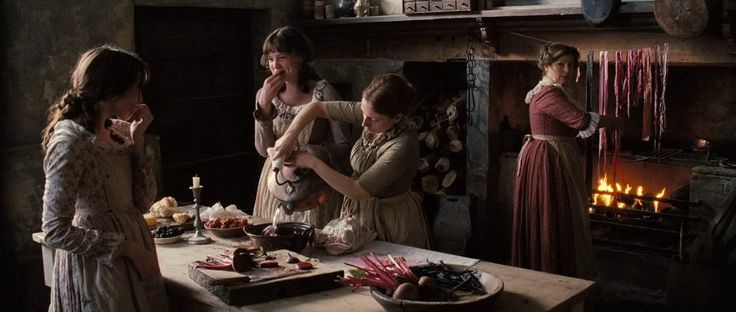
You don’t have to be superstitious to believe in the power of hoppin’ john on New Year’s Day.  Katherine’s recipe is below, but first, she takes this good excuse to talk about the structure of beans, the magical fruit (really seeds).

The magic of beans
Beans are extremely satisfying seeds.  They are large and germinate easily.  They can be harvested young and eaten soft – like limas, favas, and green peas – or in their fresh pods, like green beans and sugar snap peas.  They are most beautiful and useful when allowed to mature and dry naturally.  They are creamy white, chestnut, blue-black, or pink; mottled, speckled, cow-spotted, or black-eyed; fat and reniform, or shaped like a lens or a ram’s head.  They can weigh down pie crusts or fill bean bags.  Food co-ops everywhere are built on the cornerstones of bulk bins full of colorful dried beans.  Running your hands through a bowl of cool dried beans is an inexplicably simple joy. Continue reading

Hollies, Yerba maté, and the botany of caffeine

Yerba maté, the popular herbal tea from South America, is a species of holly. It’s also caffeinated, a characteristic shared by only a small number of other plants.

CRW_1675

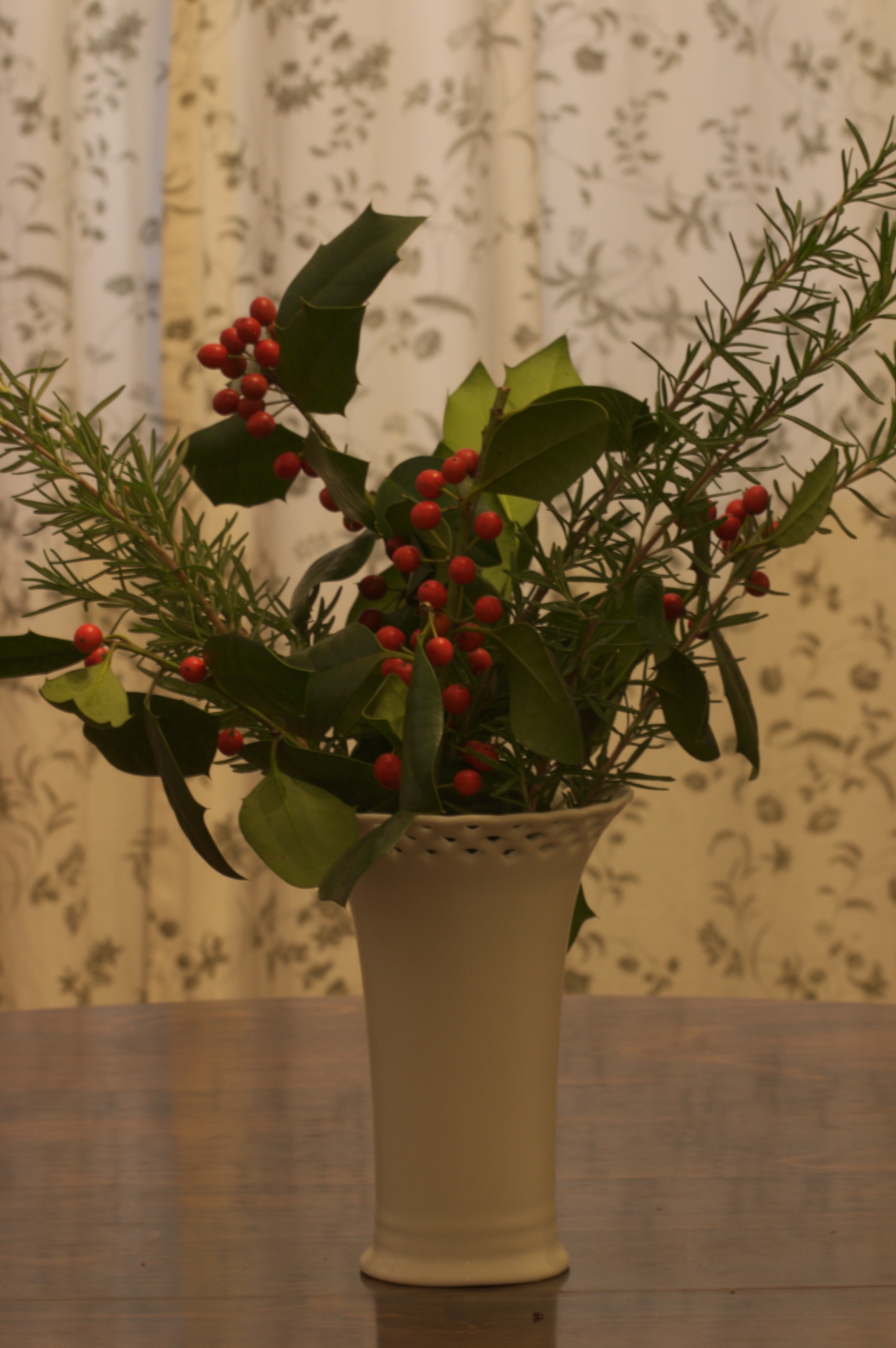
English holly. Photo by K. Bills

Along with conifer trees and mistletoe, hollies are a botanical hallmark of the winter holiday season in Europe and the United States. Most hollies are dense evergreen shrubs or small trees and produce beautiful red fruits that stay on the plant through the cold winter months. Sprays of the dark green foliage grace festive decorations, and wild and cultivated hollies punctuate spare winter landscapes. Especially popular in winter, too, are warm beverages. One of the most popular, at least in South America but increasingly elsewhere, is yerba maté. It is a seasonally appropriate choice because the maté plant is a holly. Unlike the decorative hollies, usually American (Ilex opaca) or English (Ilex aquifolium) holly, maté (Ilex paraguariensis) is caffeinated. This puts it in rare company, not only among hollies, but among all plants. Continue reading

Cranberries, blueberries, and huckleberries, oh my! And lingonberries, billberries…

Flavorful and juicy thought it may be, Thanksgiving turkey, for me, is merely the vehicle for the real star of the meal: cranberry sauce. And cranberry is in the same genus as blueberries, lingonberries, huckleberries, and billberries. And they all make their own pectin. Let us give thanks this holiday season for Vaccinium.

Cranberry sauce is my favorite staple item at our big holiday dinners. Long-prized by indigenous North Americans, cranberries would have been in the diet of those Native Americans participating in the first Thanksgiving if not part of the meal itself. When the fresh cranberries hit the stores in late fall, we stock up. Cranberries, however, are not the only member of their genus that is perennially in our freezers or in our annual diet: blueberries, many huckleberries, lingonberries, and billberries are all in the large genus Vaccinium (family Ericaceae, order Ericales). Continue reading

The irrational nature of pie

What is a nut, and why is the answer so convoluted? For Thanksgiving, Katherine explores pecans and the very best vegetarian turkey substitute ever: pecan pie.

Traditions
Thanksgiving is all about tradition, and wherever there is tradition, there are entrenched ideas about the right way to do things. Strong opinions can breed discord, judgmental grumbling, or silent rants about how people with so little sense cannot possibly be blood kin or their freely chosen companions. So much for the theory of mind we all developed as toddlers. And so it goes with my feelings about pecan pie.

Pecan pie is properly made according to the recipe on the Karo syrup bottle, preferably by my own father. The recipe does not include bourbon. To be clear, I love bourbon. Bourbon is our only indigenous whiskey. It is made of corn and aged in American oak. I love bourbon, and I respect it enough to drink it neat, from a glass, alongside my pie.

We can all agree that pecan pie should not be rolled in molasses, breaded with crushed pork rinds, and deep fried. Some reasonable people, however, do add chocolate. It might taste just fine that way – even delicious – but it disqualifies the resulting pie from the category under discussion. Sneaking it in under another name doesn’t work either. When the good bourbon-loving people of Kentucky add chocolate to a pecan pie and call it Derby pie, not only are they infringing on a trademark, they are using the wrong kind of nut. Derby-Pie ® is made with walnuts. There is therefore still no excuse for adulterating good pecan pie with chocolate.

What is a pecan?
A pecan half is a rich fat-filled embryonic leaf (a cotyledon) from a pecan tree seed. The flat side of a pecan half bears a pale shield-shaped scar where it was joined to the other cotyledon and where a tiny knobby embryonic root sits waiting for the chance to grow out and start drawing up water. Each pecan half is wrinkled like a brain hemisphere, crammed into its shell. In the natural world, when conditions are right for germination, a pecan seed imbibes water and its cotyledons swell enough to crack open the shell. The cotyledons provide an extremely calorie-dense sack lunch for the seedling to draw upon until it develops leaves and starts photosynthesizing food on its own. Continue reading

Nasturtiums and the birds and the bees

Hummingbirds and ancient bees are responsible for the color and shape of nasturtium blossoms and have a unique view of them, explains Jeanne over salad. 

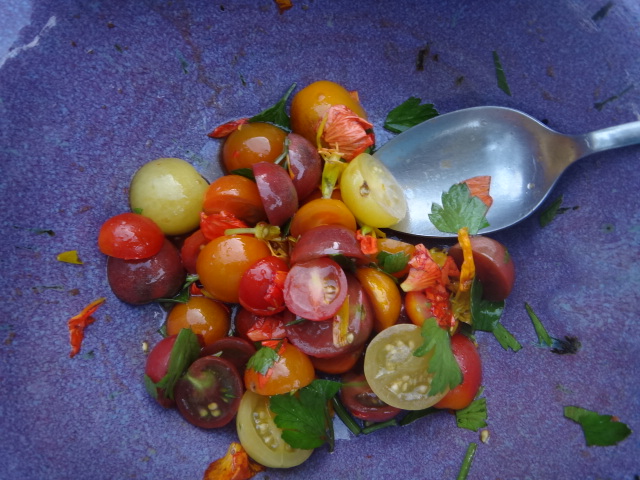
Nasturtium flowers cut into tomato salad with parsley

Nasturtium flowers cut into tomato salad with parsley

Fall frost hasn’t yet claimed our nasturtiums (Tropaeolum majus; Tropaeolaceae family). The large, colorful blooms amidst the round leaves are still spilling over planting boxes.  All parts of the plant are edible and boast spicy mustard oil glucosinolates, betraying the plant’s membership in the order Brassicales, along with the cruciferous vegetables and mustard in the Brassicaceae family, capers (Capparaceae), and papaya (Caricaceae; try the seeds, as suggested here). I’ve heard that the immature flower buds and immature seed pods can be pickled like capers, but I haven’t tried it yet. Mostly I use the flowers, throwing a few in a salad or chopping them coarsely with other herbs and stirring them into strained yogurt or butter to put on top of roasted vegetables or lentils. In addition to the mustardy kick, the sweet flower nectar adds to these dishes. Continue reading

Okra – what’s not to like?

What is hairy, green, full of slime, and delicious covered in chocolate? It has to be okra, bhindi, gumbo, Abelmoschus esculentus, the edible parent of musk. Katherine explores okra structure, its kinship with chocolate, and especially its slippery nature. What’s not to like?

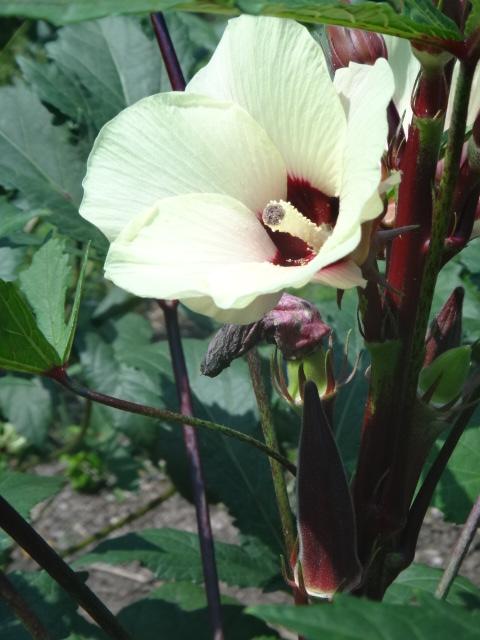
Okra flower with red fruit below

Okra flower with red fruit below

People often ask me about okra slime. Rarely do they ask for a good chocolate and okra recipe, which I will share unbidden. With or without the chocolate, though, okra is a tasty vegetable. The fruits can be fried, pickled, roasted, sautéed, and stewed. Young leaves are also edible, although I have never tried them and have no recipes. Okra fruits are low in calories and glycemic index and high in vitamin C, fiber, and minerals. The plant grows vigorously and quickly in hot climates, producing large and lovely cream colored flowers with red centers and imbricate petals. The bright green or rich burgundy young fruits are covered in soft hairs. When they are sliced raw, they look like intricate lace doilies. In stews, the slices look coarser, like wagon wheels. And yes, okra is slimy. And it is in the mallow family (Malvaceae), along with cotton, hibiscus, durian fruit, and chocolate. Continue reading

Figs and Mulberries, inside and out

A shorter version of this essay appears in the Autumn 2013 issue of the beautiful, creative online magazine Soiled and Seeded.  Here Katherine and Jeanne explain the topological relationship between figs and mulberries and do a little investigative journalism.

Mulberries

Mulberries

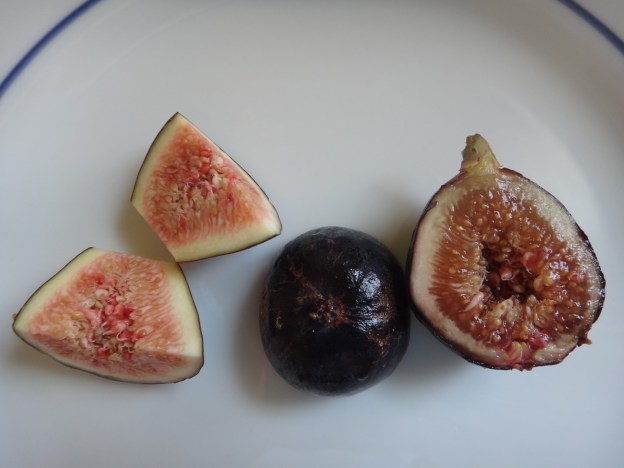
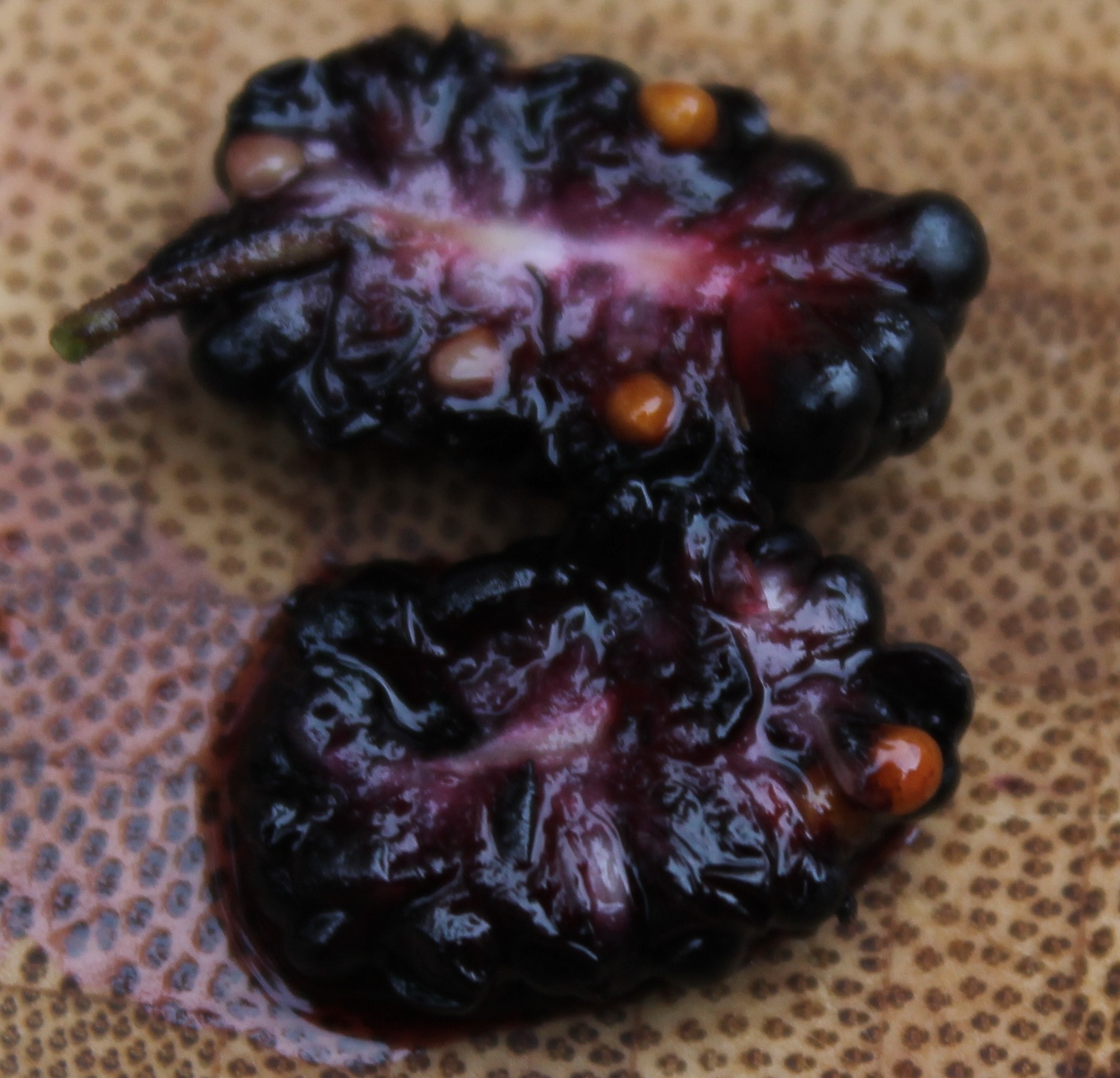
Figs and mulberries are both gorgeous, sexy fruits, but in very different ways. At first blush a mulberry could be the fragile hot-mess cousin of a blackberry, while figs are classically sensual fruits, like marble nudes teetering on the edge of vulgar. For all their fleshy assertiveness, both fruits keep their secrets; and it takes more than a long, intense gaze to uncover their close relationship and know what makes them sweet.  Mulberries may look like blackberries (and share a taxonomic order), but they are built from different plant components. The true siblings are mulberries and figs (both in family Moraceae), and at heart they are very much alike, although figs are clearly the more introverted of the two. Continue reading

Evolution of Lemon Flavor

A batch of lemon balm-lemon verbena syrup reminds Jeanne of the multiple evolutionary origins of lemon flavor.

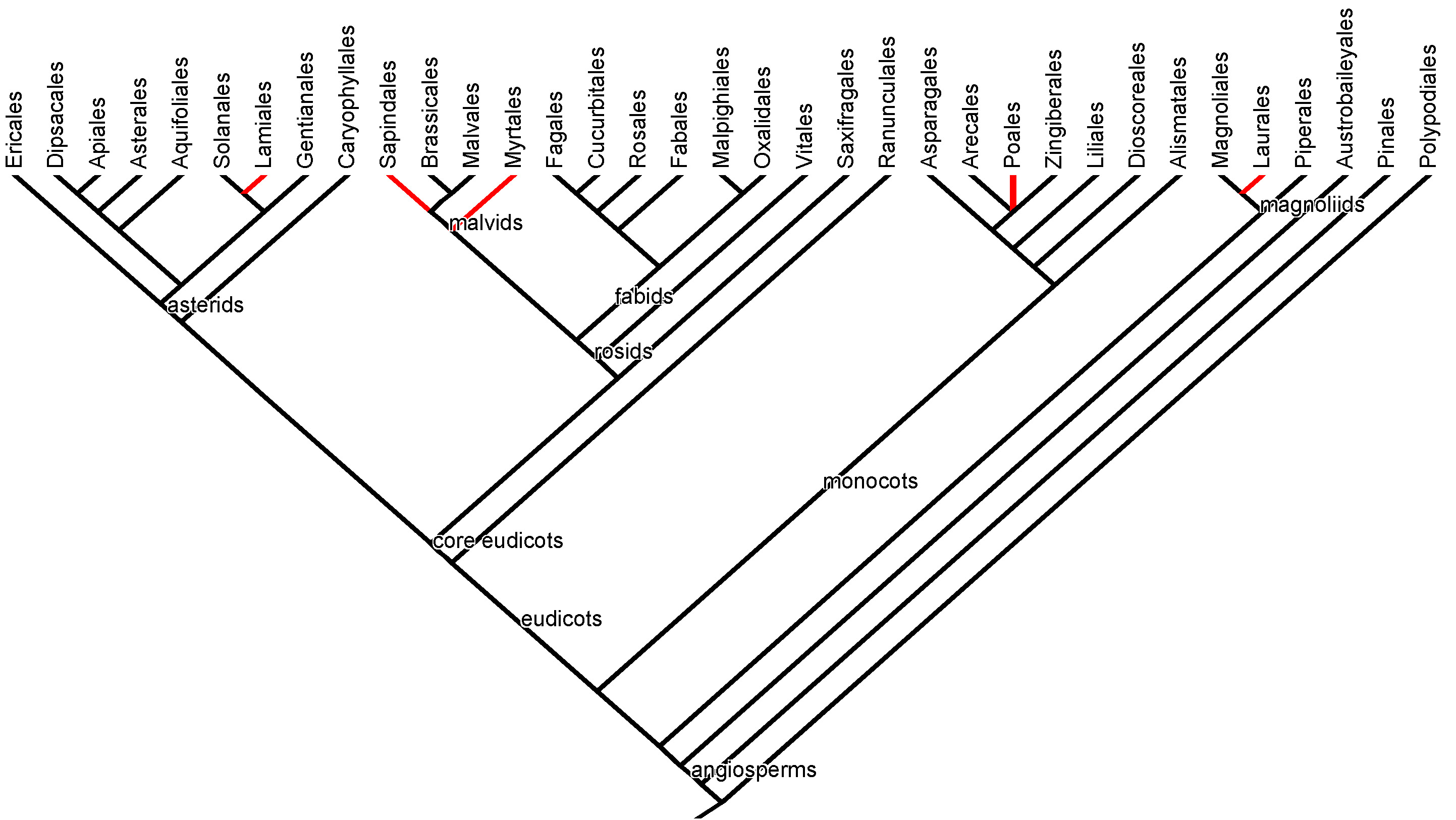
DSC00796The citrus lemon itself is only one of many plant species that lends its namesake flavor or fragrance to our food and drinks.  Lemon flavor primarily comes from a few terpenoid essential oils:  citral (also called geranial, neral, or lemonal), linalool, limonene, geraniol, and citronellal.  The production of one or more of these essential oils has independently evolved multiple times in species on widely separated branches of the plant phylogeny (see figure).

Phylogeny of plant orders with edibles (click the tree to enlarge). Orders with species with lemony essential oils are highlighted in red.  For a refresher on reading phylogenies, please see our food plant tree of life page.

Phylogeny of plant taxonomic orders with edibles (click the tree to enlarge). Orders with species with lemony essential oils are highlighted in red. For a refresher on reading this phylogeny, please see our food plant tree of life page.

Continue reading

Making ratatouille like a botanist

The story of the nightshades is usually told as a tale of European explorers, New World agriculturalists, and a wary bunch of Old World eaters.  But what about the birds?  And the goji berries?  Jeanne and Katherine introduce you to the Solanaceae family and walk you through the botany to be observed while making ratatouille, the classic French collision of Eastern and Western nightshades.

Can you imagine Italian cuisine without tomatoes? The Irish without potatoes? Chinese cuisine without spicy, fruity chiles?  Such was the case prior to the discovery of the New World nightshades (family Solanaceae) by sixteenth-century Spanish explorers.  And they couldn’t help but run into them.  Solanaceae is a huge family, with over 100 genera and nearly 2500 species, most of which are in Central and South America. Continue reading

Pear grit and the art of aging

Nostalgia emanates from a basket of pears, inspiring Katherine to explain what makes up these glorious, gritty, and gorgeous late-summer fruits.

Last week a dear friend conjured an entire autumn for me when she handed me one of her pears.  She had picked it a few days prior from one of the small espaliered trees that guard the outside of her bedroom wall and overlook her garden.  It was pale buttery gold with a pink blush, soft and honey-flavored.  A month past the solstice, we were still able to enjoy the low sun well into early evening as we sat on her deck and gazed over the garden, savoring the fruit.Rosaceae talking pear

Bartlett pears, like my friend’s, ripen in the summer and yet they herald the fall.  They appear, and we start the inevitable tumble towards apples, wool socks, and the bittersweet baseball postseason.  Other popular varieties, such as Bosc and d’Anjou, tend to arrive later, when we have already come to terms with shorter cooler days.

I love apples, but they are not as emotion-laden for me.  Whereas apples seem timeless, even summer pears carry an old fashioned patina.  They evoke a time when canning was a skill necessitated by the Depression, but which still made a lot of good sense.  My grandmother must have spent a thousand hours canning the soft sweet pears from her trees.

Pears also know how to age right.  Apples are harvested ripe from the tree, but pears should be taken when they have reached their full size and before they are ripe.  My friend always picks her pears before the squirrels can mark them with bite-sized divots, a practice that also happens to keep them from becoming mealy on the tree.  She sent me home that day with a bag of firm green Bartletts and instructions to hold them in a bag in my kitchen for a couple of days.  Summer varieties don’t require chilling, but d’Anjou and Comice pears benefit from a month of nearly freezing temperatures, followed by ripening at room temperature (Stebbins et al).  The proper aging of pears is all about managing the activity of enzymes that alter various compounds and break down cell walls.  Such treatment would ruin high-maintenance peaches, which are horrified by the thought of getting old and don’t take well to chilling. Continue reading