A very close look at potato leek soup

To understand how potatoes behave in the stock pot, Katherine puts a favorite soup under the microscope – literally.

Potato leek soup is the perfect soup. It is heaven pulled from the ground in all its humble grassy beauty. Potato leek soup is good-looking, simple, and flexible. It can be made vegan and provides nutrients and fiber with few calories. It is cheap, scales up for a crowd, and freezes well. Plus you have to love a soup with more names than ingredients. As a comforting wintertime staple, we call it what it is – potato leek soup. In tiny cups, sprinkled with chopped parsley and freshly ground black pepper, it becomes potage Parmentier, a rich tasting but delicate entrée to an elegant dinner party * . Chilled, with fresh cream, it is Vichyssoise, the cool, light partner of a good baguette and a glass of Pouilly-Fumé on the patio in summer. And my mother-in-law has demonstrated many times that when the holidays overwhelm your fridge, you can store a huge pot of potato leek soup on the porch overnight – as long as you put a brick on the lid to keep the raccoons out.

This amazing soup is the just about easiest thing in the world to make. Julia Child’s version is probably the most widely used, and the one I like: simmer equal parts cubed potato and sliced leek in water until they are tender. Add salt to taste and puree. A bit of cream is optional. A dusting of chopped parsley and freshly ground black pepper is divine. I like to err on the side of more potatoes than leeks, but the soup is robust to variations in proportion.

But is it really so easy? If you trust the internet more than you trust your favorite dog-eared chocolate-spattered cookbook with the broken spine and decades of marginalia (silly you), you may worry that without the right kind of potato and extremely careful handling, your soup will end up gluey. Is any wallpaper not pre-pasted these days? Doubtful, but everyone seems to describe gluey potato soup or mashed potatoes as “wallpaper paste.” I will say right up front that gluey soup has never happened to me, but given all the stress over this utterly simple soup, it seemed worth investigating. Continue reading

A look at leeks

FLUELLEN …and I do believe your majesty takes no scorn to wear the leek upon Saint Tavy’s day.
KING HENRY V I wear it for a memorable honour; For I am Welsh, you know, good countryman.
Shakespeare, Henry V, act 4, scene 7

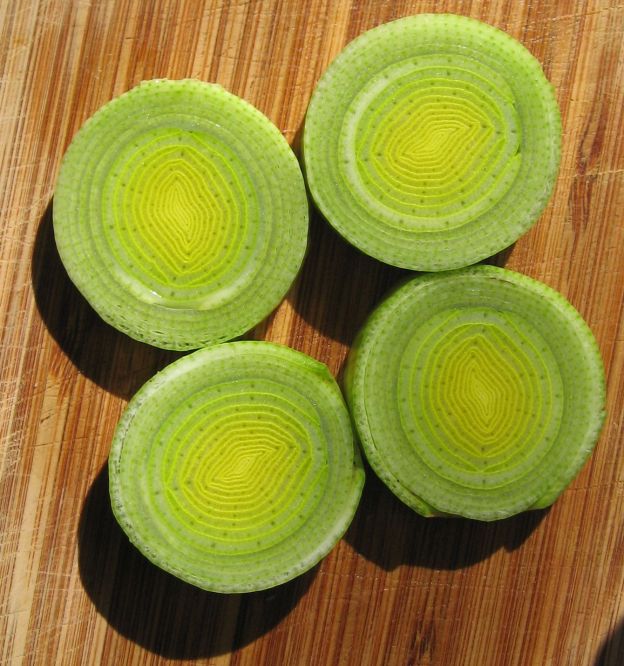
Break out the daffodils and leeks!  This past Friday, March 1, was St. David’s Day, the feast day of the patron saint of Wales and a national holiday in that country.  As long as you are cleaning and slicing leeks, let’s take a quick close look at the vegetable, one of the national symbols of Wales. Continue reading

Pomegranates and the art of herbivore attraction

Jeanne walks you through the botany you need to know to understand pomegranate fruit structure.  Jeanne’s definition of “need to know” is arguably a bit broad and includes a brief tour of the many different structures plants modify in order to entice herbivores, and at least one goddess, to disperse seeds. 

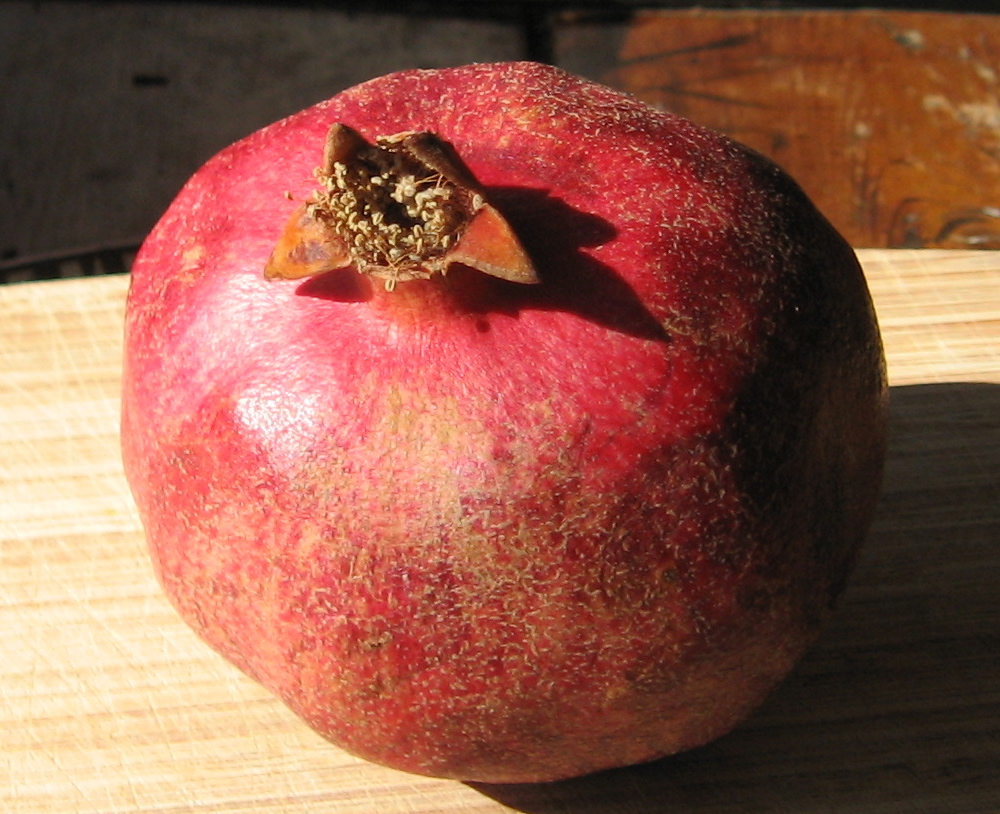
pomegranate fruit (persistent calyx and stamens visible)

pomegranate fruit (persistent calyx and stamens visible)

Pomegranates (Punica granatum, family Lythraceae, rosid order Myrtales) were one of the earliest domesticated plant species.  According to ancient Greek mythology, they even predate the seasons.  The story goes that Hades, god of the underworld, kidnapped his beloved Persephone, daughter of Demeter, goddess of the harvest.  Demeter’s grief over Persephone’s disappearance caused the crops to wither and wreaked havoc with humanity.  The plight of the starving masses coerced Zeus to convince Hades to return Persephone to her mother.  Before she left the underworld, however, Hades tricked her into eating a pomegranate seed, which bound her to evermore spend part of the year with her happy mother, during which time plants flourished, and part of the year in the underworld, during which time plants go fallow. Thus, seasons arose.

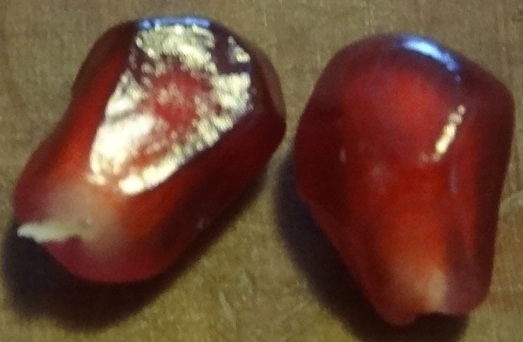
Pomegranate seeds

Pomegranate seeds

We can hardly blame poor Persephone for finding pomegranate seeds irresistible.  They look like faceted jewels and have a refreshing, tangy sweetness and a satisfying crunch. We have an additional reason to be drawn to pomegranates: even if they can’t help us understand the seasons, deciphering the structures of the beautiful pomegranate fruit helps us understand the diversity of mechanisms plants use to entice animals, including humans, to disperse seeds.  The delicious, nutritious or fibrous attractive structure is payment for the animal’s labor. As you will see in this post, there is no single anatomical recipe for creating the colorful, fleshy and/or juicy reward for a seed-dispersing herbivore, mortal or otherwise.  Many of the myriad flower, fruit and seed structures are variously promoted to the role of what is colloquially thought of as “fruit.” Continue reading

Welcome to 2013, the International Year of Quinoa

Can we call quinoa a grain? Why do people care?  Where did all these geese feet come from, and what does Ban Ki-moon have to do with it?  On long winter runs, Katherine’s mind wanders over such questions.

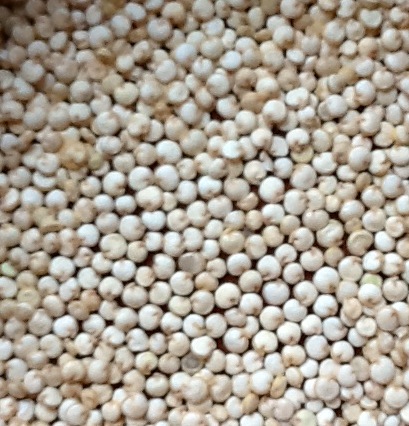
Quinoa seeds (Chenopodium quinoa)

Quinoa seeds (Chenopodium quinoa)

In the final two months of 2012, questions about quinoa and its status as a “grain” came up three separate times within my earshot.  This was odd in itself, but it launched a cascade of coincidences.  On a run near the baylands, my mind was idling back over those conversations, when I noticed for the first time a little weed along the trail, looking much like one of quinoa’s relatives, a saltbush.  (The crushed specimen I carried home in my shoe laces keyed out as Atriplex semibaccata, Australian saltbush.)  There is also a gorgeous and much larger saltbush species along the trail, and yet another relative, an edible Salicornia species (“sea beans”) that fills the marshy areas next to the bay.  Along with quinoa, spinach, beets, and chard, all of these species belong to the (former) goosefoot family – the Chenopodiaceae – which is now considered a branch nested within the Amaranth family.  Quinoa is a central member of this old family, belonging in the namesake genus Chenopodium. Continue reading

The most interesting layer of wax in the world

It’s high season for kale and apples, and Katherine just can’t stop talking about epicuticular wax

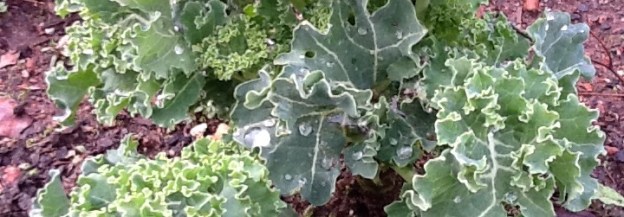
There is something nostalgic about kale and its softly glowing dusky cast that suits late autumn and early winter. It looks rustic and thick-skinned, steeled against falling temperatures and short days. It even shrugs off winter rains. Water beads up and rolls right off its leaves. Kale’s ageless still-life look is due to its extraordinary epicuticular wax, a legacy of the first plants to survive on dry land. Continue reading

The holidays mean persimmons

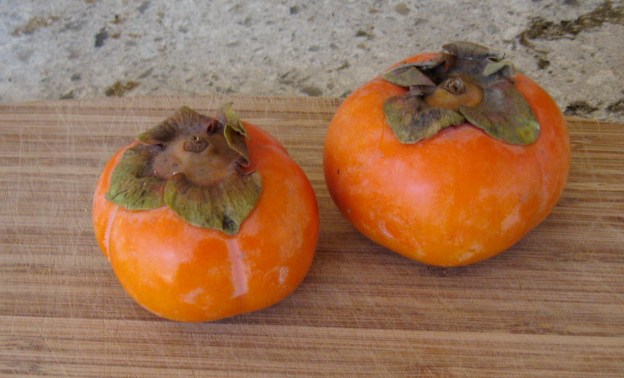
Hachiya persimmons, ripening

Hachiya persimmons, ripening

Jeanne discusses the biology behind the strange winter beauty of persimmon trees and demystifies why eating one before its time is an unpleasant experience.

The holiday seasons of my adult life increasingly include persimmons.  The ‘hachiya’ persimmons on my mother-in-law’s tree in California ripen around Christmas, beginning a conversation about what to do with them, and when they start showing up in the grocery store in late fall, I’m invariably drawn to the plump orange fruits with their handsome green calyxes.  I’ve now learned that persimmons, especially dried, are an important part of many new year celebrations throughout Asia, where there are thousands of persimmon varieties, but I only became acquainted with them when I moved from Denver to go to college in the Bay Area, where some of the Asian varieties are grown.  The bright orange plum-to-apple-sized persimmon fruits stay on the tree until well after the leaves drop in the autumn.  I paid little attention to the persimmon trees on campus—tall specimens of the ‘hachiya’ variety of Asian Diospyros kaki—until the leaves fell to reveal the scraggly branches laden with the orange orbs. Continue reading

A brief history of gluten

Victory with creating a gluten-free quick bread recipe inspires Jeanne to give you a brief primer on the evolutionary history of gluten within the grass family. 

We were perhaps a little too enthusiastic this fall in our apple picking at a local orchard and our acquisition of interesting squash at our farmer’s markets.  Our freezer now contains many bags of applesauce and squash puree.  We must now “do something,” as we say, with all of it, meaning use the purees as ingredients.  Lately I’ve been working on incorporating the purees into nutritious (low sugar, high protein, whole grain) quick breads.  On my doctor’s recommendation, that quick bread also needs to be gluten-free.  Increasing appearances of the phrase “gluten free” on restaurant menus and product labels are noble efforts to accommodate the needs of people who have celiac disease or other dietary sensitivities to gluten.  Baking without gluten is a challenge, as gluten is what gives wheat dough its elasticity and allows yeasted wheat bread to rise.  The internet makes gluten-free baking more accessible by the day, but I haven’t yet found someone else’s recipe that really does what I want, so I’ve been working on my own.  I’m fairly pleased with the latest result (below) and thought I would use the occasion to give you a brief evolutionary history of gluten and the botanical family that makes it:  the grasses. Continue reading

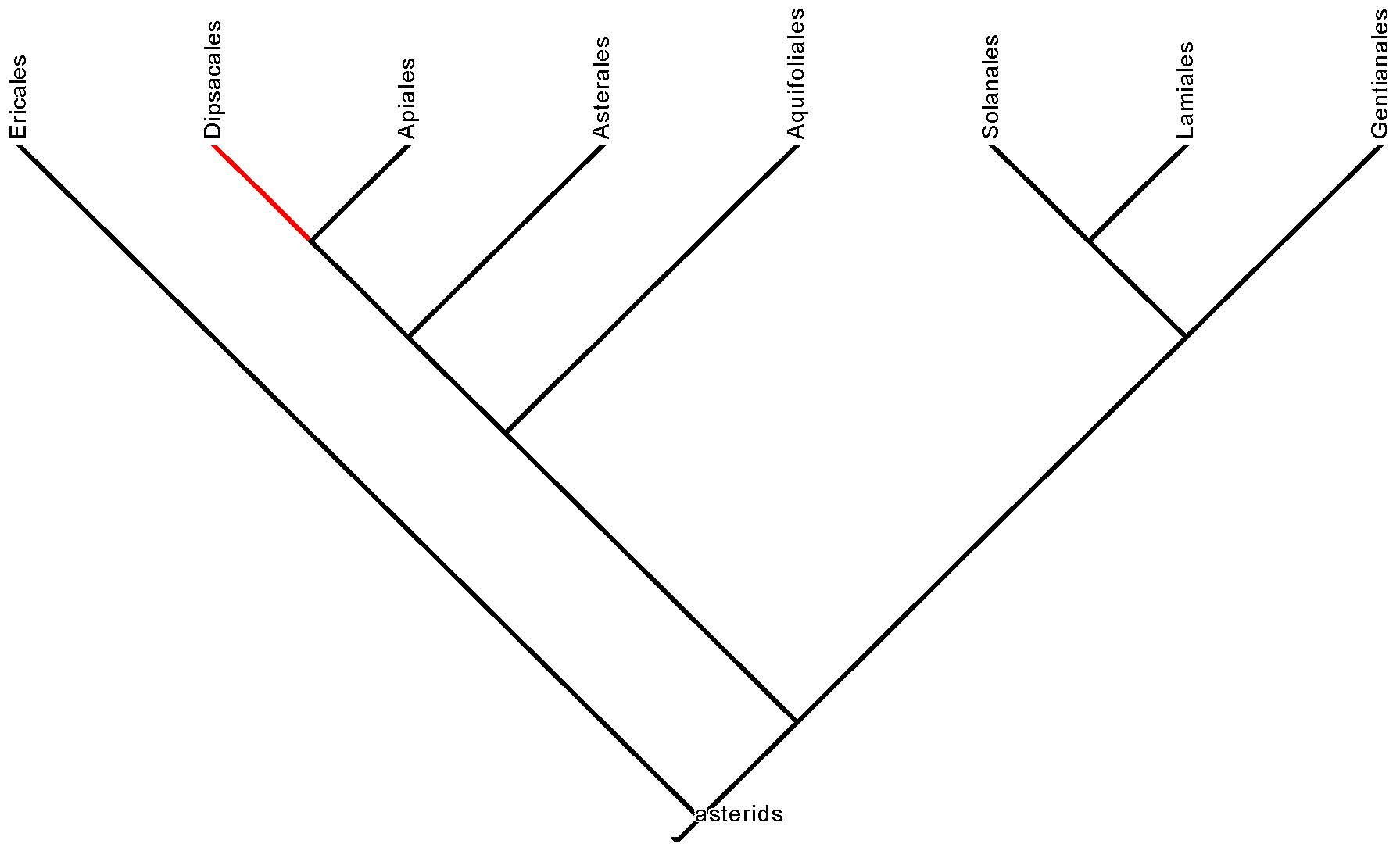
Have a salad and relax: the Dipsacales trio

The three edibles from the order Dipsacales (mâche, elderberry and valerian) inadvertently make their way into Jeanne’s evening.

As I added some dried valerian (Valeriana officinalis) root to my bedtime tea mixture, I realized that in doing so I had inadvertently incorporated the only three common edibles from the order Dipsacales into my evening:  elder, mâche, and valerian.  These three make the Dipsacales a lonely but interesting and delicious branch of the asterid group of eudicots (see our phylogeny page for phylogenetic contextualization of the asterids):

Orders in the asterids, Dipsacales in red

Orders with edibles in the asterids, Dipsacales in red

Continue reading

Of sweet potatoes and putting down roots

On a hunt for a traditional Thanksgiving tuber, Katherine discovers what it takes to root your own sweet potatoes.  Here she explains how sweet potatoes are put together, which anyone can observe in the kitchen.

The Sunday before Thanksgiving – the first Thanksgiving in 19 years that I have not spent with my family in Georgia – I was on a hunt for sweet potatoes.  Not a single one of my favorite vendors at the Mountain View farmers market grew them this year.  Finally, I questioned Luis Miranda of Wholeness Farms, who has always given me clear and patient explanations of many aspects of farming.  In his charming Nicaraguan accent, he simply said that sweet potatoes are a “long crop.”

Sweet potatoes of all kinds – orange, white, or purple, garnets, Beauregards, Georgia jets, and white stars – are members of the species Ipomoea batatas, in the morning glory family, Convolvulaceae. Continue reading

The most political vegetables: A whirlwind tour of the edible crucifers

arugula

Jeanne provides an overview of the cultivated brassicas.

Two days after the re-election of Barack Obama, the arugula at the farmer’s market reminded me of John Schwenkler’s excellent commentary from the 2008 campaign season on political trends in food choices, taking issue with Republican opposition to arugula. Arugula was the subject of a gaffe by then-candidate Obama.  Afterward the vegetable joined lattes in the pantheon of foodstuffs entirely in custody of liberals, according to some pundits on the political right.

broccoli

Arugula was not the only, or even the most recent, brassica (a species from the mustard family, Brassicaceae) to be dragged into the American political fray.  Marion Nestle has a great commentary on two memorable instances when broccoli entered national political discourse, first when George H. W. Bush disavowed the vegetable, and then recently when Antonin Scalia turned the vegetable into a symbol of government imperialism during the Supreme Court’s consideration of the Affordable Care Act.

cabbage

In July 1948 Truman called both houses of Congress back from recess for what is now known as the Turnip Day Session, starting on, as he said, “what we in Missouri call Turnip Day,” the 25th of July.  The designation comes from an old Missouri saying: “On the 25th of July, sow your turnips, wet or dry.”  During World War I sauerkraut in the United States for a time became “Liberty cabbage,” a marketing predecessor to the Freedom Fries in the George W. Bush-era congressional cafeteria.  The re-labeling came from American manufacturers of sauerkraut, the German name for the lacto-fermented salted cabbage popular in much of Europe and Asia, who worried that Americans would reject a product with a German name (incidentally, though smelly, making your own sauerkraut is easy and yields satisfying results).

watercress

The relative frequency of brassica appearances in political discourse reflects their abundance in the modern grocery cornucopia.  In previous posts we discussed the numerous varieties of Brassica oleracea (including kale, collard greens, Chinese broccoli, Brussels sprouts, kohlrabi, cabbage, broccoli, and cauliflower) and other Brassica species (turnips, rutabagas, rapini, napa cabbage, tatsoi, bok choy, mizuna, mustard greens, mustard seeds, mustard or canola oil).  This post completes our whirlwind tour of Brassicaceae food plant diversity. Continue reading