
The Gather and Sow: October 2026 newsletter is out.
Pumpkins and other winter squashes are gloriously large fruits and are therefore excellent subjects for easy botanical observation. Carving a Jack-O-Lantern or cutting up a squash for a recipe becomes an instructive dissection when you know what to look for. We walk through the necessary information in this month’s Botany Lab of the Month. Before that we provide a brief overview of squash diversity in Food for Thought. We conclude with recent relevant media and journal articles in Gleanings and Baker’s Dozen. But, first, this cartoon from Errant Science that ties some of our summer newsletter topics to this one:
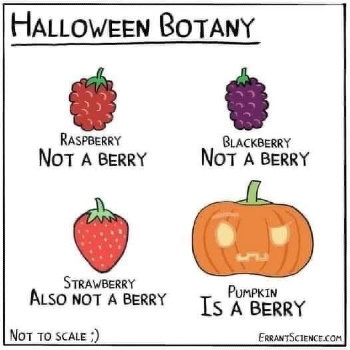
Strictly botanically speaking, a “berry” is just a fleshy fruit that arises from a flower with a single ovary. The cartoon hilariously illustrates that the colloquial use of “berry” sometimes clashes discordantly with the botanical definition. In casual speech, a berry is a smallish, juicy thing, regardless of how many ovaries the flower in question might have (raspberry and blackberry flowers have numerous ovaries, as we discussed in July’s newsletter), or whether a flower’s ovary was involved at all (the delicious part of a strawberry arises from the flower’s receptacle, not ovary, as we showed in June’s newsletter). Several fruits comfortably fit both definitions, such as blueberries (Vaccinium) and grapes (Vitis). Some botanical berries, though, like tomatoes and eggplants (Solanum), aren’t thought of as smallish and sweet. Squashes, cucumbers, and melons (and loofah!)–the cucurbits (family Cucurbitaceae)–are all pepos, a special type of berry. They develop from flowers with a single inferior ovary, surrounded by a protective hypanthium. The hypanthium fuses to the ovary wall to make the hard rind that surrounds the mature fruit (more on this below in Botany Lab of the Month). We showed in last month’s newsletter that apple flowers also have inferior ovaries. The apple hypanthium develops into delicious tissue instead of a hard rind, making apples pomes, not pepos.

